
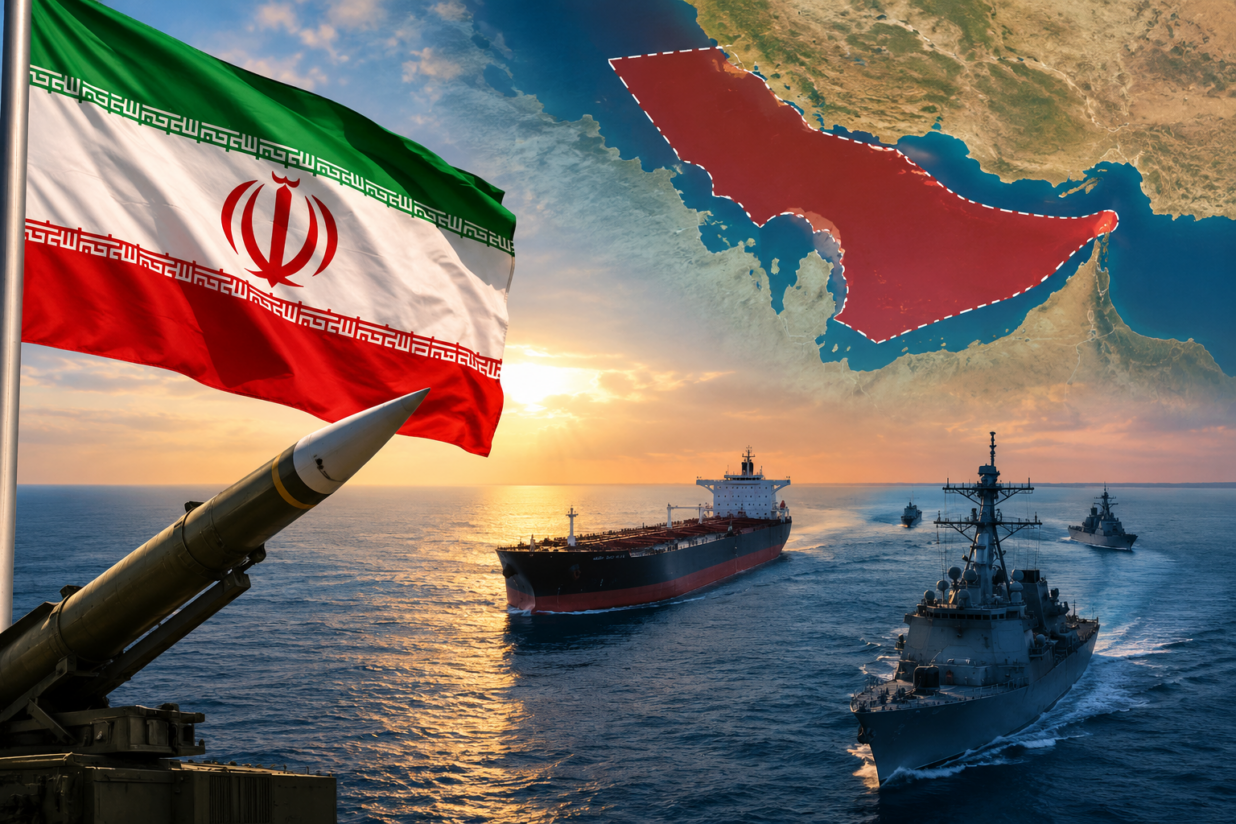
Iran has warned the United States that it could create a new Iran Gulf Exclusion Zone across parts of the Persian Gulf if Washington continues its economic pressure. Tehran has also claimed that it used a new missile against U.S. warships near the Strait of Hormuz, raising the risk of another escalation in the six-month-old conflict.
Iranian officials claimed the new marine restrictions would be unveiled in the following days. Tehran is also scheduled to disclose maps of a planned shipping route via the Strait of Hormuz, though no particular date has been set for the disclosure.
Iran Gulf Exclusion Zone Could Cover Areas Near US Blockade
Mohsen Rezaei, secretary of Iran’s Supreme National Security Council, stated that the proposed restricted area would begin near the point where the US embargo of Iran begins and stretch into areas of the Gulf.
He stated that ships entering the zone may be added to an Iranian sanctions list. On Tuesday, Rezaei reaffirmed the warning, stating that Washington’s economic actions would be matched with maritime limitations in the Persian Gulf.
Despite US efforts to maintain the Strait of Hormuz open, Iran continues to disrupt shipments via it. The strait is a vital route for worldwide oil and liquefied natural gas supplies.
The rising tensions come after another round of military action between the two sides. The US last acknowledged strikes on Iranian targets on Saturday, when its forces targeted three Iranian oil tankers. Iran’s state media later reported that it had fired a Qassem Basir missile.
Iran Highlights Qassem Basir Missile
Iran has defined the Qassem Basir as an enhanced ballistic missile with improved maneuverability. According to Iranian claims, its guidance technology can successfully combat electronic warfare and assist missiles in avoiding missile defense systems.
According to Fars News Agency, the missile was first used in warfare against Israel in June 2025. Rezaei appeared to be referring to the weapon when he said Iran’s new rockets had sent a warning to Washington.
The US military, on the other hand, claimed that its warships were not targeted by the purported missiles. Despite significant US assaults that have damaged Iran’s conventional military forces and put additional strain on its economy, Tehran maintains missile and drone capabilities.
These weapons might be deployed against shipping in the Strait of Hormuz or against Gulf states with US military bases.
Strait of Hormuz Remains Key to Iran’s Strategy
Prior to the battle, the Strait of Hormuz carried around one-fifth of global oil and liquefied natural gas supplies. The canal remains a key source of leverage for Iran, particularly against Gulf countries that rely on energy exports.
However, shipping activity has dropped significantly. Data showed that only about ten commodities vessels went through the strait per day over the previous ten days, the lowest amount since May.
Some observers say Iran’s capacity to use the waterway as leverage is eroding as US sanctions put additional strain on its economy.
President Donald Trump has stated that if the United States wins the battle, oil prices will decrease dramatically. He also stated that Iran will not be permitted to get a nuclear weapon.
The confrontation began on February 28 with strikes by the United States and Israel on Iran. Trump started “Operation Epic Fury” with the goals of halting Iran’s nuclear program, limiting its ability to attack neighboring nations, and creating conditions for a change in Iran’s leadership.
So far, Iran’s clerical leadership is still in control. Tehran is seeking sanctions relief and intends to someday collect tolls from ships passing through the Strait of Hormuz.
The larger battle is likewise uncertain. According to Lebanon’s health ministry, Israel struck southern Lebanon on Monday, killing at least 12 people. Despite the June ceasefire with Iran-backed Hezbollah, the strikes have stoked concerns about a resumed Israeli campaign, which might complicate efforts to reach a larger agreement.
- Join our whatsapp channel for daily updates.
- Follow tazatimesnews Telegram Channel for latest news alerts.
- Follow TazaTimesNews on TruthSocial for exclusive updates
- Also reads : Sydney Heatwave Brings Extreme Bushfire Risk as Temperatures Reach 33°C