
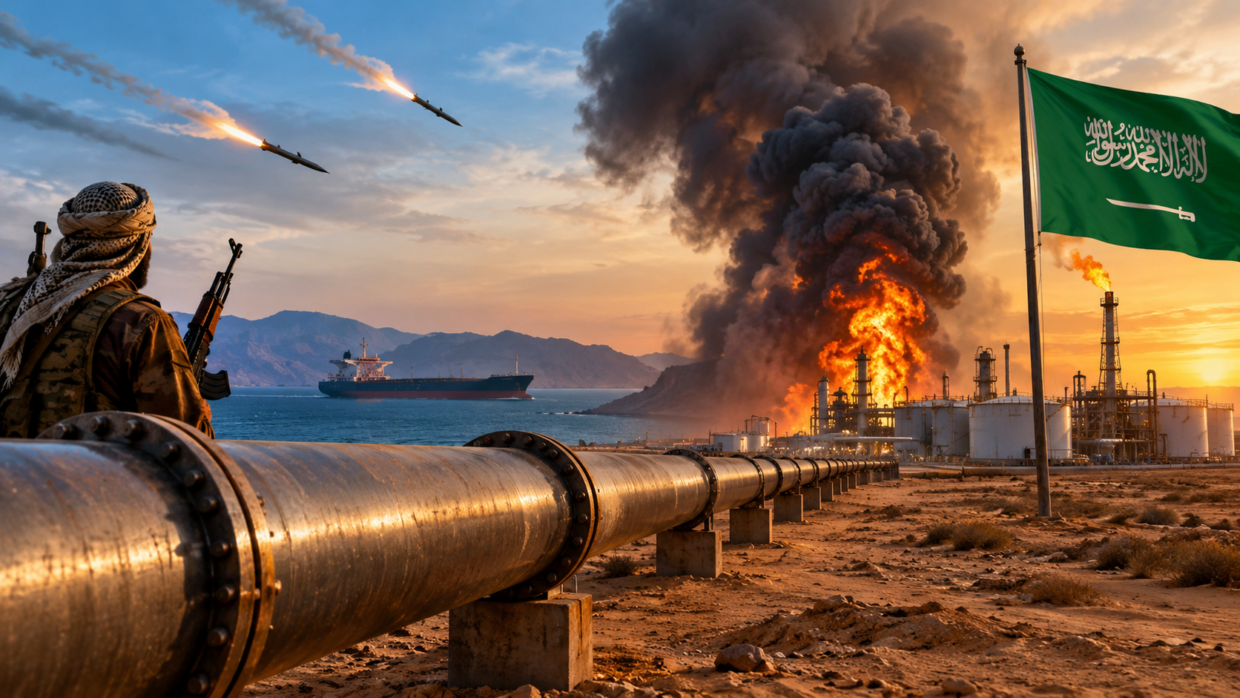
The Saudi oil pipeline may have come under attack as fighting between Saudi Arabia and Yemen’s Iran-aligned Houthi movement intensifies. Satellite images and fire-detection data show signs of a possible fire along the route of the strategically important East-West pipeline, but there is no independent confirmation that the pipeline itself was damaged.
A big smoke cloud was allegedly visible in the desert southeast of Medina. The location is near the pipeline’s main course as it travels toward Mahd adh-Dhahab.
NASA’s FIRMS satellite system also discovered a number of temperature abnormalities in the region. However, the information only shows potential current flames. They are unable to confirm what caused the fire or whether the pipeline was harmed.
The revelation comes following a large number of Houthi missile and drone attacks on southern Saudi Arabia on September 8. Strikes were reported in Jazan, Abha, Najran, and Khamis Mushait. Saudi Arabia has reacted with airstrikes targeting Yemeni targets.
Why the Saudi Oil Pipeline Is Important
The East-West Pipeline, commonly known as Petroline, is an important component of Saudi Arabia’s oil network. It runs for approximately 1,200 kilometers, transporting crude from oil-producing and processing facilities in Abqaiq in the Eastern Province to Yanbu on the Red Sea.
The pipeline has grown even more essential amid the US-Iran conflict since it allows Saudi Arabia to transport oil to the Red Sea without relying on the Strait of Hormuz.
Following a previous attack in April, Saudi Arabia restored the pipeline to its full declared capacity of approximately 7 million barrels per day. Any confirmed damage might have far-reaching consequences than an attack on a single oil plant.
Yanbu has also become increasingly important for Saudi crude exports. Crude and condensate shipments from the Red Sea port had recovered to around 3.7 million barrels per day in early September, according to Vortexa data.
Houthi Moves Raise New Concerns
The probable pipeline fire was discovered at a critical moment for Saudi Arabia’s energy infrastructure.
The Houthis recently seized control of Mocha, a vital Yemeni port in the Red Sea, and advanced toward the Hanish Islands. Their move may increase strain on shipping routes around the Bab al-Mandeb Strait and Saudi Arabia’s Red Sea export network.
Shipping through Bab al-Mandab has already reduced by approximately 60% as a result of previous Houthi attacks. At the same time, traffic via the Strait of Hormuz has decreased dramatically. Only seven vessels crossed the strait on Wednesday, compared to a 10-day average of 14.
This puts Saudi Arabia under strain on both major routes that potentially let it bypass Hormuz. A danger to the East-West pipeline would jeopardize the country’s ability to transport crude to international markets.
Oil Markets Watch the Situation
The developments are also being keenly monitored by the oil markets. Brent crude reached $108.68 a barrel on Friday, while US West Texas Intermediate climbed to roughly $103.45. Both benchmarks were poised for their largest weekly increases in months.
Murban crude prices also rose considerably, reaching $122 as of 11:15 a.m. Tokyo time.
Saudi crude production fell to 6.24 million barrels per day in August 2026, according to OPEC figures provided by the kingdom. The decrease occurred as the country encountered disruptions to western export lines during the larger Iran war.
If the reported fire is confirmed as an attack on the Saudi oil pipeline, it will pose a new level of risk. The confrontation would thus jeopardize not only Saudi Arabia’s sea routes, but also the land-based infrastructure intended to provide an alternative to the Strait of Hormuz.