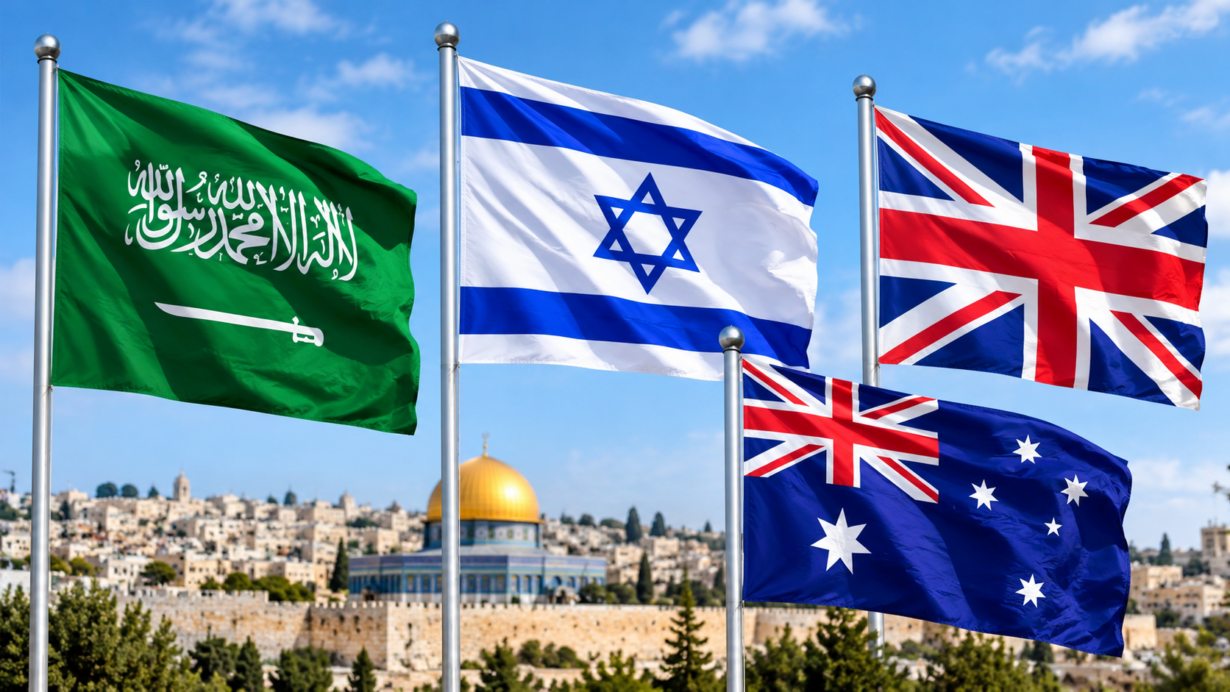
The United Kingdom and Australia have levied penalties against companies and individuals associated with Israeli settlement development in occupied Palestinian land, which Saudi Arabia and fifteen other nations have supported. Additionally, the nations have demanded more robust international action to stop future settlement projects and policies that seek Israel seize Palestinian territory.
The 16 nations’ foreign ministers revealed the stance in a unified statement on Thursday. They voiced support for efforts to hold persons engaged in settlement-related activities responsible and applauded the actions taken by Canberra and London.
The declaration also emphasized the necessity of international efforts to halt settlement growth and defend Palestinian rights under international law.
Saudi Arabia Backs Action Against Israeli Settlements
Saudi Arabia, Jordan, Egypt, Pakistan, Indonesia, Qatar, the United Arab Emirates, Niger, Palestine, Libya, the Maldives, Turkey, Kuwait, Algeria, Somalia, and Oman all supported the united declaration.
The ministers applauded the penalties announced by the United Kingdom on Tuesday and Australia on Wednesday. British authorities targeted eight businesses that were involved in settlement expansion schemes. Australia imposed restrictions on three people and four organizations.
The countries stated that accountability procedures should include individuals who promote, facilitate, or carry out settlement expansion and annexation initiatives. Their statement notably mentioned the E1 settlement plan, which was listed among the actions requiring international attention.
The ministers also endorsed the United Kingdom’s move to penalize Tzav 9, an Israeli organization accused of impeding humanitarian relief delivery to Gaza.
They hoped that the current actions will inspire other governments to adopt similar steps. Their stance represents a need for greater international participation in addressing settlement-related activities.
The foreign ministers also urged Israel to halt settlement construction and growth. They were opposed to any further measures that sought to alter the geographical and demographic makeup of the occupied Palestinian areas.
Gaza Conflict and Two-State Solution Remain Key Demands
Beyond the settlement problem, the 16 countries expressed worry about the intensification of Israeli military actions in Gaza. They urged for the full and urgent execution of US President Donald Trump’s Comprehensive Plan to End the Gaza Conflict, which has been endorsed by the United Nations.
The ministers stated that following the plan was critical to ensuring security and stability, improving the humanitarian situation, and allowing reconstruction and recovery activities in Gaza to proceed.
They also underlined the need for a two-state solution to the Israeli-Palestinian problem in order to be long-lasting and equitable. According to their declared position, an independent and sustainable Palestinian state should be founded along the June 4, 1967 lines, with East Jerusalem as its capital.
The statement also refers to the International Court of Justice’s advisory opinion delivered on July 19, 2024. The ministers emphasized that other states must not recognize Israel’s illegal occupation of Palestinian territories.
They also emphasized the importance of governments avoiding any support that could contribute to the occupation’s continued existence. This legal position was another key component of their call for international action.
The ministers emphasized that settlement expansion, annexation policies, and developments in Gaza must be handled through international cooperation and adherence to relevant United Nations resolutions.
Conclusion
The unified statement of Saudi Arabia and 15 other nations includes a number of demands about Israeli settlement construction, the situation in Gaza, and the future of Palestinian statehood. Their support for UK and Australian sanctions is accompanied by a demand for other countries to adopt comparable accountability measures. The ministers want Israel to stop settlement operations and not change the character of the occupied Palestinian territory. They have also urged for the Gaza peace plan to be implemented, as well as resumed efforts to achieve a two-state solution. Their statement establishes a common diplomatic position, while emphasizing international law and the June 4, 1967, borders as the cornerstones of their proposed path to permanent peace.
- Join our whatsapp channel for daily updates.
- Follow tazatimesnews Telegram Channel for latest news alerts.
- Follow TazaTimesNews on TruthSocial for exclusive updates
- Also Read : Israel Election Results: Netanyahu Faces Coalition Challenge as Rivals Weigh Arab Alliance