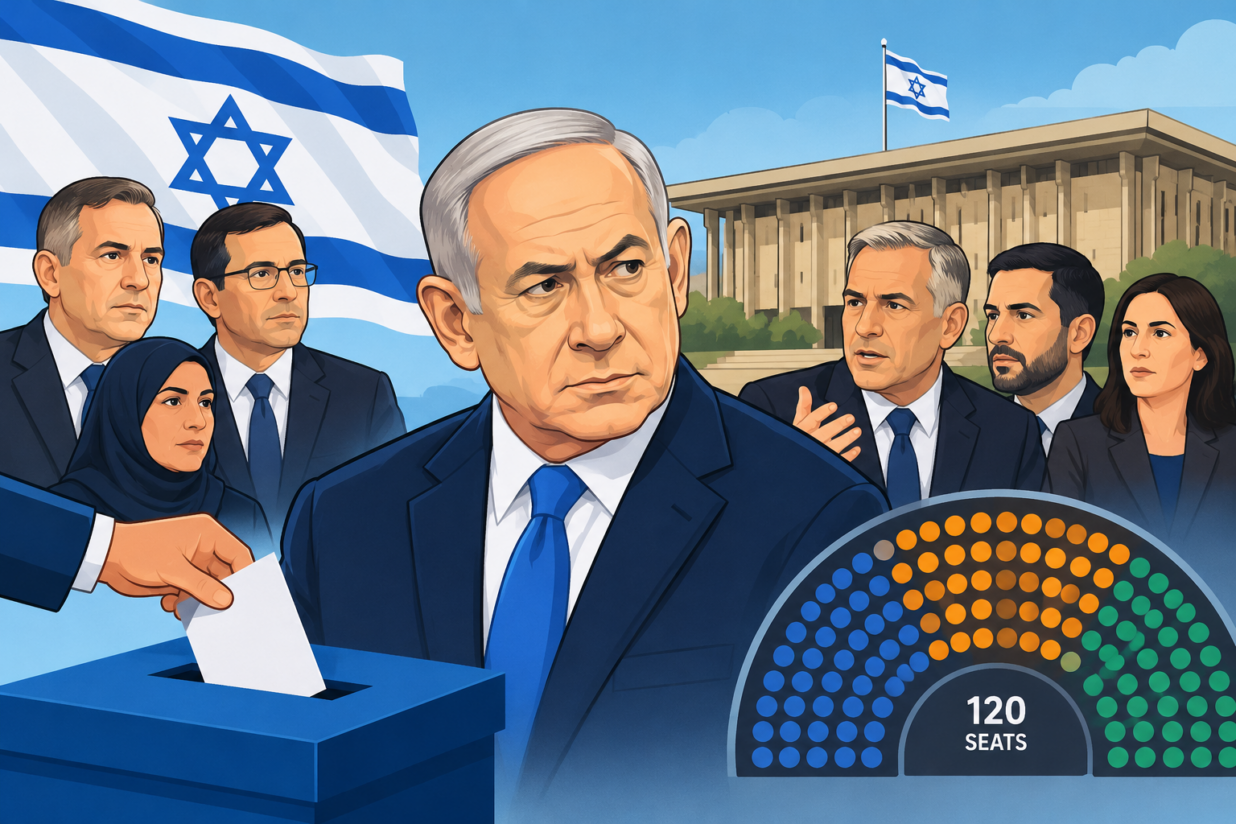
Israel Election Results : Israel’s election has left Prime Minister Benjamin Netanyahu with a difficult task of building the next government, as neither major party bloc is expected to gain a legislative majority. The results have put Arab-led parties in a potentially pivotal position, as opposition leaders ponder whether to collaborate with them to remove Netanyahu’s leadership.
With 89.8% of votes counted, Netanyahu’s coalition was expected to win 53 seats in the 120-member Knesset. The opposition coalition, led by moderate former military chief Gadi Eisenkot, was anticipated to gain 48 seats, leaving both sides short of the 61 required for a majority.
The two main Arab-led parties were projected to win 19 seats combined. Their performance could influence coalition negotiations, although political disagreements over cooperation with Arab parties remain a major obstacle.
Israel Election Results Put Arab Parties in Key Position
The high performance of Arab-led parties has established a potential path for Netanyahu’s opponents to gain a legislative majority. However, it is unclear whether enough opposition politicians will agree to work with them.
Netanyahu has categorically rejected a coalition with Arab-led parties, branding such cooperation traitorous. On Wednesday, he again warned against forming a “dangerous government” with these parties. They, in turn, have rejected joining a coalition led by him.
Eisenkot, who leads the Yashar party, has hinted at the potential of collaborating with Arab-led parties under specific situations. These include identifying Israel as a Jewish state and classifying Hamas as an extremist organization.
Yair Golan, whose Democratic Party favours the inclusion of Arab-led parties in a ruling coalition, has also called for an end to political tensions between Jewish and Arab voters. The argument highlights ongoing difficulties over Israel’s national identity and the role of Arab citizens in national politics.
Arab citizens account for around 20% of Israel’s population. Many are the descendants of Palestinians who stayed in the country after its founding in 1948. They have faced discrimination and mistrust because of their support for Palestinian rights, and distrust has grown after the Hamas-led attack on October 7, 2023.
Arab voters turned out in historic numbers in Tuesday’s election, hoping to oust Netanyahu and his far-right supporters from office. The expected combined total of 19 seats would break the previous record of 15 held by Arab-led parties.
Israel Election Results Leave Netanyahu in the Race
Despite losing support since the 2022 election, Netanyahu remains in contention to form the next government. His Likud party was projected to retain its lead, despite a drop in vote share from 23.4% in the previous election.
The results also revealed that the opposition had not scored a clear victory, despite widespread outrage over the October 7 attack and displeasure with Netanyahu’s far-right allies. Concerns about military service exemptions for many ultra-Orthodox Jewish men influenced the election.
National Security Minister Itamar Ben-Gvir, one of Netanyahu’s far-right friends, also lost popularity. He has faced criticism for his treatment of Palestinian inmates and comments regarding Gaza residents.
Vote counting was likely to continue until Thursday evening, with approximately 500,000 absentee ballots remaining, including those from military members and diplomats. The Central Election Committee stated that the official results must be validated by November 4.
Voter turnout rose to about 78%, the highest level since 1999. President Isaac Herzog stated on Wednesday that measures should be taken to avoid a repeat election. He is not constitutionally obligated to choose the leader of the largest party to head coalition talks.
Eisenkot has also asked party leaders to accept the outcome and try to build a government. If no leader can secure a majority, Israel may face another election early next year. Another option is to form a minority government with support from parties outside the coalition.
For the time being, the result is determined by whether Netanyahu or his challengers can gain sufficient parliamentary backing. The predicted strength of Arab-led parties has made their involvement vital to the discussions, although political opposition may still hinder a deal.
- Join our whatsapp channel for daily updates.
- Follow tazatimesnews Telegram Channel for latest news alerts.
- Follow TazaTimesNews on TruthSocial for exclusive updates