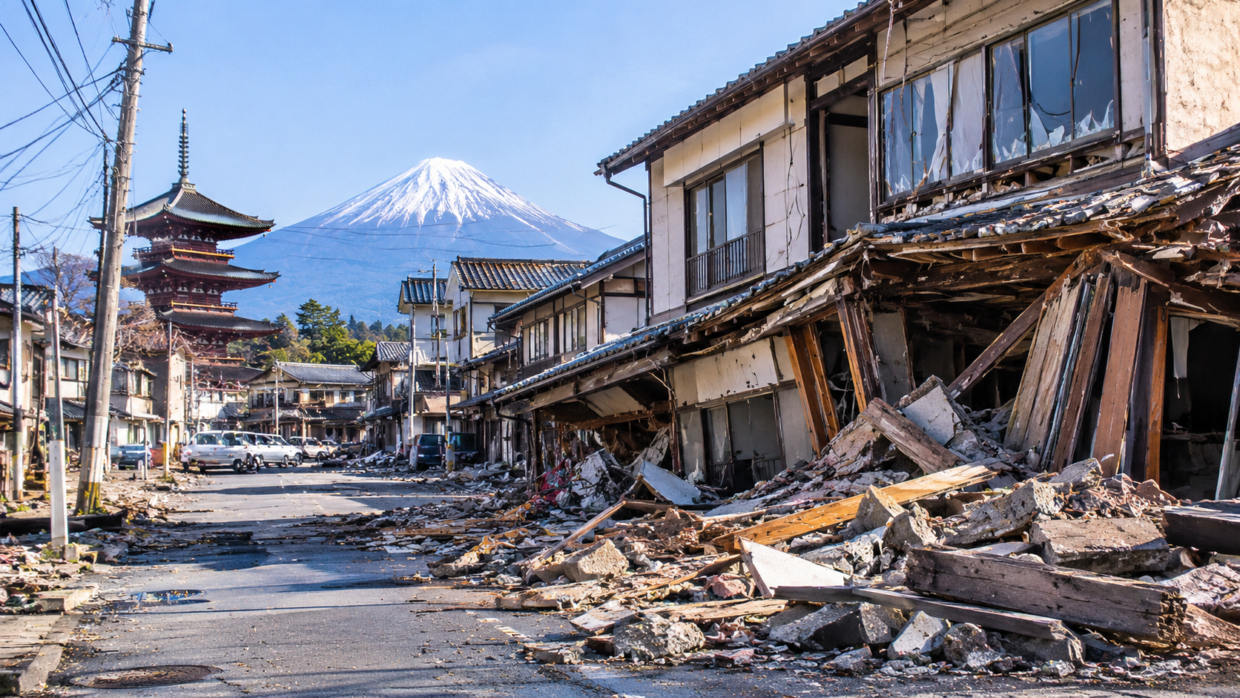
Japan Earthquake : Early on Sunday, a powerful earthquake in central Japan caused at least 22 injuries. Numerous stores were destroyed, windows were broken, and people were forced to flee buildings due to the earthquakes. The impacted areas were further disrupted by smaller aftershocks that followed the initial earthquake.
The magnitude of the earthquake was 5.7, according to the Japan Meteorological Agency. Its center was located in Shizuoka Prefecture, approximately 40 kilometers below the surface, and it hit at 1:04 am local time.
A large region close to Aichi Prefecture felt the tremor. Tokyo, however, was far enough away from the epicenter to not be affected by the earthquakes.
Japan Earthquake Causes Injuries and Store Damage
The impact was seen in several areas. Television images showed damaged store windows and glass fragments spread across surrounding streets. The vibrations also drove occupants and other persons within buildings to flee to safer areas.
Some of the injured victims collapsed while attempting to flee. According to reports, some individuals lost their balance on staircases while rushing out of buildings during the earthquake.
The impacted area encompassed many regions of central Japan. These included Hamamatsu and surrounding prefectures like Yamanashi and Gifu. Kyoto and Nara, two cities of historical significance, were also part of the larger territory.
Although the earthquake was centered in Shizuoka Prefecture, its impacts were felt well beyond that area. Aichi was one of the regions where significant shaking was observed. Meanwhile, lesser aftershocks struck shortly after the initial earthquake.
Japan Earthquake Slows Shinkansen Bullet Trains
During the earthquake, train operations underwent adjustments. Shinkansen bullet trains in the impacted areas were operating at lower speeds as a safety precaution.
Rail operators adopted this precaution because significant earth movement might cause harm to railroad rails. As a result, reducing train speeds helps to mitigate potential dangers while services remain operational in impacted areas.
Because of its geographical location, Japan is subject to earthquakes on a frequent basis. The nation is located near the meeting point of four main tectonic plates and is part of the Pacific Ring of Fire, one of the world’s most active earthquake zones.
- Also Read : Israel Election Results: Netanyahu Faces Coalition Challenge as Rivals Weigh Arab Alliance
The Pacific Ring of Fire is responsible for nearly 90% of earthquakes globally. Every year, Japan endures hundreds of minor tremors. Many of these are too subtle for individuals to detect.
The nation also experiences over 10% of the world’s large earthquakes, with a magnitude of 6.0 or higher. These occurrences add to the thousands of lesser tremors that occur around Japan each year.
Conclusion
The earthquake in central Japan wounded at least 22 people and damaged shop windows, with minor aftershocks following the initial jolt. Its impacts were felt in places surrounding Aichi, including sections of the larger region including Hamamatsu, Kyoto, and Nara. Although Tokyo did not experience the earthquake, the event prompted precautionary alterations in bullet train operations. Shinkansen services were halted in impacted regions due to the potential for railroad track damage caused by powerful earthquakes. Because of its proximity to four main tectonic plates and the Pacific Ring of Fire, Japan faces frequent seismic activity. The Sunday earthquake serves as yet another reminder of the devastating effects that powerful shocks may have on people, buildings, and transportation systems.