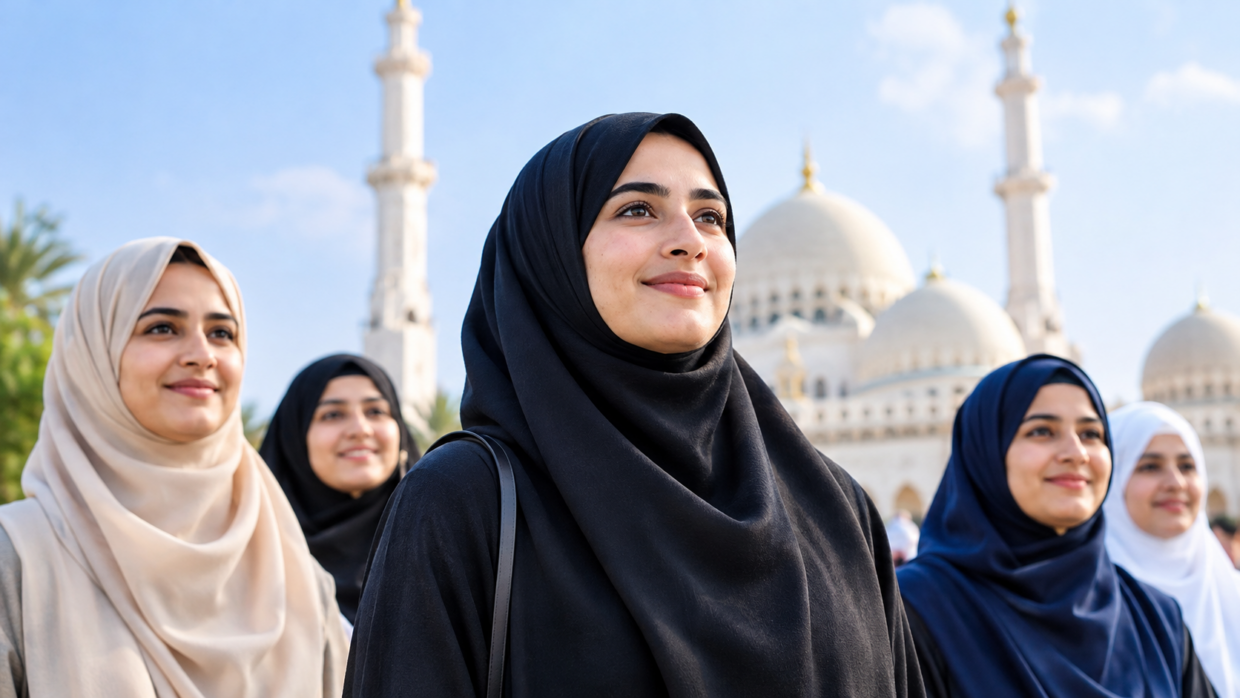
Islam Largest Religion: Islam is on track to become the world’s largest religion by 2035, surpassing Christianity, as birth rate disparities continue to change global religious demography. According to recent Pew Research Center forecasts, the Muslim population is growing faster than any other major religious group.
According to the data, the margin between Muslims and Christians will close over the next decade, with Islam taking the lead. Both religions are anticipated to rise, but the Muslim population will grow at a far faster rate.
According to Pew, there will be around 2.27 billion Christians and 2.02 billion Muslims worldwide in 2020. By 2035, the Muslim population is expected to reach 2.57 billion, while Christians will number 2.52 billion.
The longer-term perspective reveals an even greater disparity. If present trends continue, the Muslim population might approach 3.6 billion by 2070, while the Christian population is predicted to remain just around 3 billion.
Islam Largest Religion: Birth Rates Drive Population Growth
Higher fertility rates are a primary driver of the shifting religious balance. According to Pew Research Center’s 2020-2025 predictions, Muslim women had an average of 3.1 children, compared to 2.5 Christian women.
The average for women from other religious groups was 1.6 children. This is less than the replacement level of 2.1 children per woman, which is typically required to sustain a population over generations.
During the same time span, Muslim moms gave birth to an estimated 252 million infants globally. Christian moms accounted for around 208 million births.
Conrad Hackett, a senior demographer at Pew, emphasized that disparities in fertility have a significantly greater influence on population change than religious conversions.
The analysis also identifies Africa as a key place for future growth. Much of the predicted population growth will occur in Sub-Saharan Africa, where Christianity and Islam are the dominant religions.
By 2070, this area is predicted to house more than half of the world’s Christians. The Democratic Republic of the Congo is expected to overtake the United States as the country with the greatest Christian population, with roughly 299 million people.
In addition, the Muslim population is predicted to grow significantly in some nations. Pakistan may have the world’s biggest Muslim population by 2070, followed by India, Nigeria, and Indonesia.
Islam Largest Religion: Global Religious Shifts by 2070
The predictions show that religious change will not occur at the same rate everyplace. While Islam and Christianity are predicted to increase in absolute numbers, their proportion of the world population will differ from that of other religions.
The global population is expected to rise by 29% between 2020 and 2070. During that time, the Muslim population might expand by 80%, while the Christian population is predicted to grow by 30%.
Hindus and Jews are also expected to grow in number, however their proportion of the world’s population may drop. Buddhism’s population size and worldwide proportion are predicted to decline, due in part to diminishing populations in China, South Korea, and Japan.
Europe is projected to follow a different trajectory. Its entire population might decrease by 17% by 2070. The number of Christians in the region is expected to decrease from 505 million in 2020 to 324 million.
Similarly, Muslims might make for 13% of Europe’s population by 2070, up from 6% in 2020.
Changes are also anticipated in North America. Christians presently account for 62% of adults in the United States, however this ratio may fall below half by 2065. Canada is expected to lose its Christian majority even early, by 2030.
This trend is characterized by a rise in the number of persons who do not identify as religious. This group, often known as religiously unaffiliated or ‘nones’, comprises atheists, agnostics, and those who do not identify with any religion.
By 2070, unaffiliated persons might account for 41% of the US population and exceed Christians in Canada. Excluding China, their global population is predicted to grow by more than 180 million.
Conclusion
According to the most recent forecasts, worldwide religious demography are anticipated to change dramatically in the future decades. Higher birth rates and population growth in sub-Saharan Africa are predicted to have a significant impact on the spread of Islam and Christianity. If present trends continue, Islam might become the world’s largest religion by 2035, with its population increasing even more by 2070. However, the statistics do not indicate that one religion’s expansion inevitably comes at the price of another. The projection continues to focus on population trends, fertility rates, and age disparities. The data also show an increasing number of people who choose no religious affiliation, notably in various Western countries.
- Join our whatsapp channel for daily updates.
- Follow tazatimesnews Telegram Channel for latest news alerts.
- Follow TazaTimesNews on TruthSocial for exclusive updates
- Also Read : Gadi Eisenkot Gets First Chance to Form Israel’s Next Government