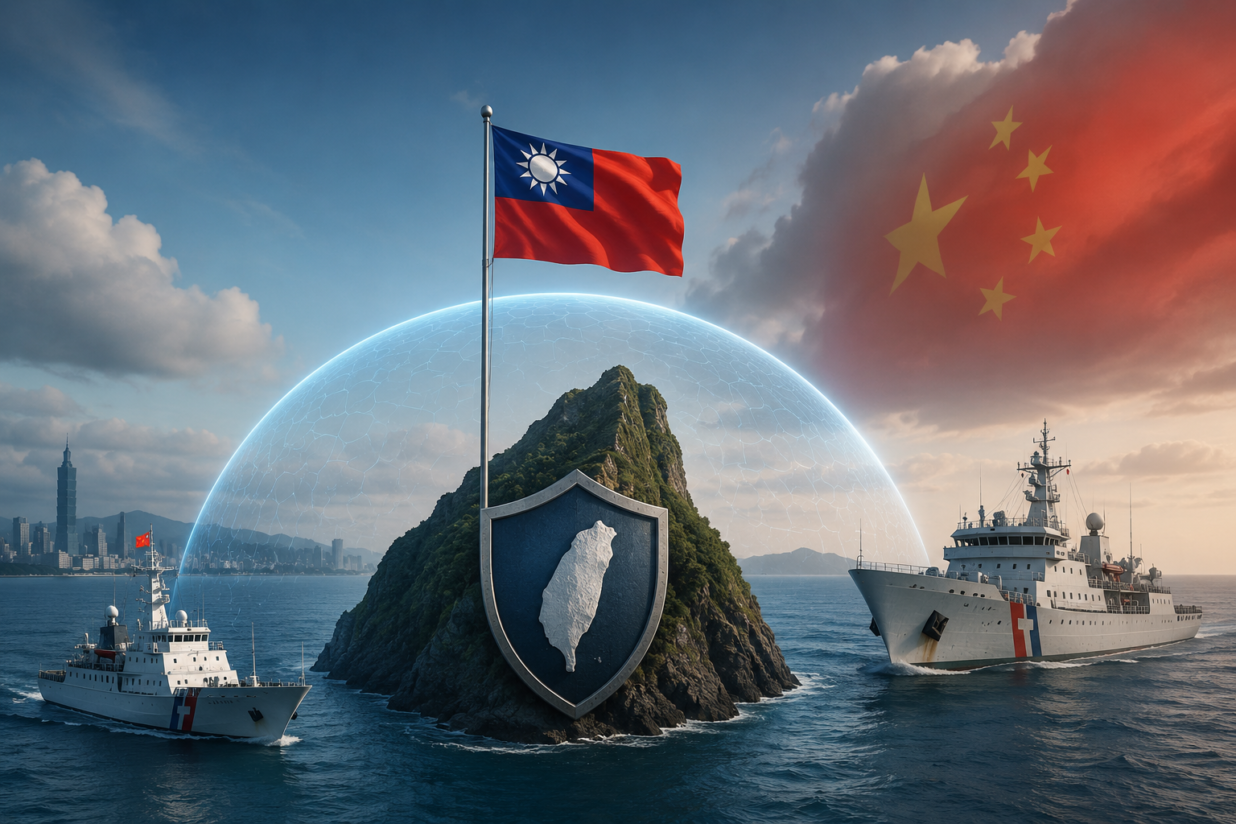
Taiwan has flatly rejected China’s recent attempts to exert authority in waters surrounding the island, claiming that external measures cannot challenge its sovereignty and maritime rights. The announcement came after China completed a contentious coast guard patrol mission that heightened already strained relations across the Taiwan Strait.
The dispute arose after Chinese coast guard warships patrolled the waters east of Taiwan. Beijing defended the operation as a reasonable attempt to preserve its territorial and maritime rights. Taiwan, on the other hand, firmly opposed, claiming that China lacks legal authority over the region and cannot enforce jurisdiction there.
Taiwan’s Coast Guard Administration stated that it would continue to protect the island’s maritime boundaries and would take measures against any attempts to interfere with its freedom of navigation. Officials emphasized that Taiwan’s territorial rights are safeguarded by international law and cannot be altered by patrols or political pressure.
The current issue follows increased maritime activity around Taiwan and occurs at a time when regional governments are closely monitoring security developments in East Asia. China’s military aircraft and navy boats have routinely operated near Taiwan in recent years, raising fears about regional stability.
Taiwan Sovereignty Dispute Deepens Amid Maritime Confrontation
Taiwanese politicians exploited the end of the Chinese patrol to underscore their belief that only the Taiwanese people had the right to decide the island’s future. President Lai Ching-te has consistently called for dialogue with Beijing, arguing that Taiwan’s democratic system and self-government must be respected. China, on the other hand, still considers Taiwan to be part of its territory and has refused to hold official negotiations with Lai’s administration.
The patrol action was apparently tied to China’s concerns to maritime boundary talks between Japan and the Philippines. Beijing contended that such talks could have an impact on the waters it claims near Taiwan. Taiwanese officials downplayed those worries, claiming that China was attempting to project a false sense of power over areas where it has no recognized jurisdiction.
Foreign policy experts believe the event is part of a larger push for influence and control in the surrounding waterways. Maritime patrols are increasingly being utilized by nations to bolster territorial claims without engaging in direct military conflict. While such efforts may avoid imminent violence, they frequently lead to long-term diplomatic tensions.
Taiwan Sovereignty Debate Draws International Attention
The most recent interaction between Taipei and Beijing has sparked interest from neighboring countries and worldwide observers. Many governments are keeping an eye on developments because the Taiwan Strait is one of the world’s most vital shipping routes and a key hub for global trade. Any increase in regional instability might have far-reaching economic and security implications.
Analysts remark that, while the Chinese patrol has finished, the fundamental conflict has not been settled. Both sides maintain opposing positions on sovereignty, maritime boundaries, and political power. As a result, similar instances are expected to occur in the future.
Taiwan’s recent response was designed to convey a strong message that maritime rights and sovereignty cannot be established through unilateral action. For China, the patrol was another attempt to bolster its territorial claims. The divergent viewpoints underline the ongoing challenges to cross-strait relations as well as the larger desire for stability in the Asia-Pacific region.
- Join our whatsapp channel for daily updates.
- Follow tazatimesnews Telegram Channel for latest news alerts.
- Follow TazaTimesNews on TruthSocial for exclusive updates
- Also reads : New Expressway: Beginning in February, vehicles on the Delhi-Dehradun Expressway will go at full speed.