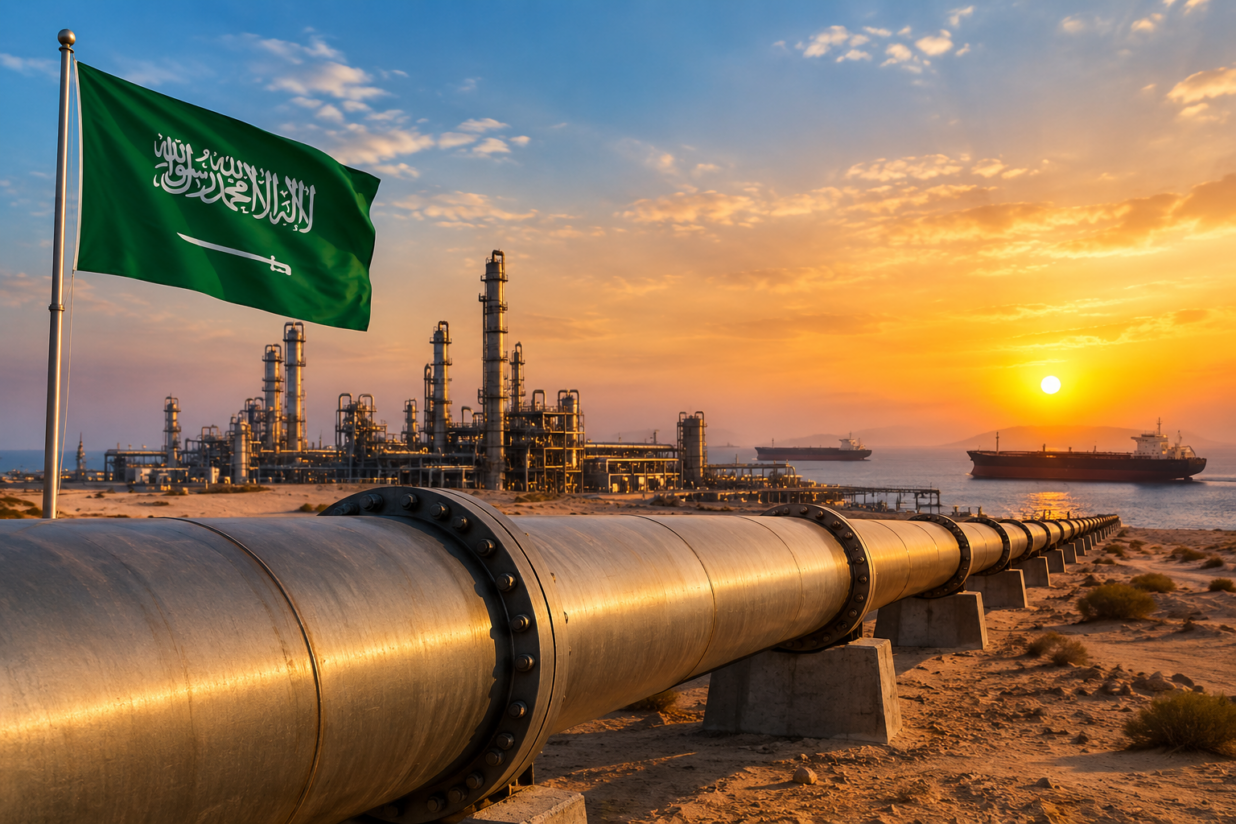
The Saudi pipeline shutdown could put a major share of the country’s oil exports at risk if the key route to the Red Sea is not restored within days. The pipeline normally carries about 4 million barrels of oil per day, equal to roughly 4% of global supply.
The east-west pipeline was closed following drone assaults on Friday. Saudi Arabia has not yet released detailed details regarding the damage or stated when the line will resume normal operations.
Saudi Pipeline Shutdown Puts Export Stocks Under Pressure
The embargo has forced Saudi Arabia to rely on oil stored in Red Sea and Mediterranean ports. According to industry sources, Yanbu storage may only handle exports for five to seven days if the pipeline stays out of service.
Saudi Arabia can also draw on supplies stored in Egypt’s Red Sea port of Ain Sukhna and its Mediterranean port of Sidi Kerir. However, those stockpiles are finite and will soon deplete if the pipeline is unable to resume pumping.
Yanbu has a storage capacity of around 35 million barrels. Ain Sukhna can hold approximately 18 million barrels, whereas Sidi Kerir can store approximately 20 million barrels. The current stockpile is not full.
The pipeline has been especially important in recent months because it allows Saudi Arabia to move oil without depending entirely on the Strait of Hormuz. The route crosses the Arabian Peninsula and sends crude to Yanbu on the Red Sea.
Repair Time Remains Unclear
There are many estimates for how long repairs might take. According to one industry source, the damage might take five to six weeks to repair, while another suggests the pipeline could return sooner and operate at a reduced capacity while repairs are underway.
The uncertainty comes as global oil supplies are already under pressure. Saudi oil production decreased to approximately 6.2 million barrels per day in August, down from 10.9 million barrels per day in February prior to the war.
According to the International Energy Agency, Saudi oil supply fell to its lowest level in more than 30 years in August. It also predicts global oil supply to shrink by 5.7 million barrels per day this year, or around 6%.
Wider Supply Risks Add to Pressure
Prior to the war, the Middle East supplied about 22 million barrels of oil per day. Oil flows through the Strait of Hormuz have since decreased to an estimated 6 to 9 million barrels per day.
Saudi supplies are under threat from more than only the pipeline outage. On Friday, Houthi forces in Yemen endangered Saudi oil supply and took control of an island near the Red Sea’s entrance.
Saudi Arabia has not publicly verified the amount of damage to the pipeline or provided a specific schedule for repairs. If the route stays closed for an extended period of time, the country’s export reserves may suffer further, and global oil markets may see another big supply interruption.
- Join our whatsapp channel for daily updates.
- Follow tazatimesnews Telegram Channel for latest news alerts.
- Follow TazaTimesNews on TruthSocial for exclusive updates
- Also reads : Registration for the Haryana Teacher Eligibility Test 2025 is now open; best apply here.