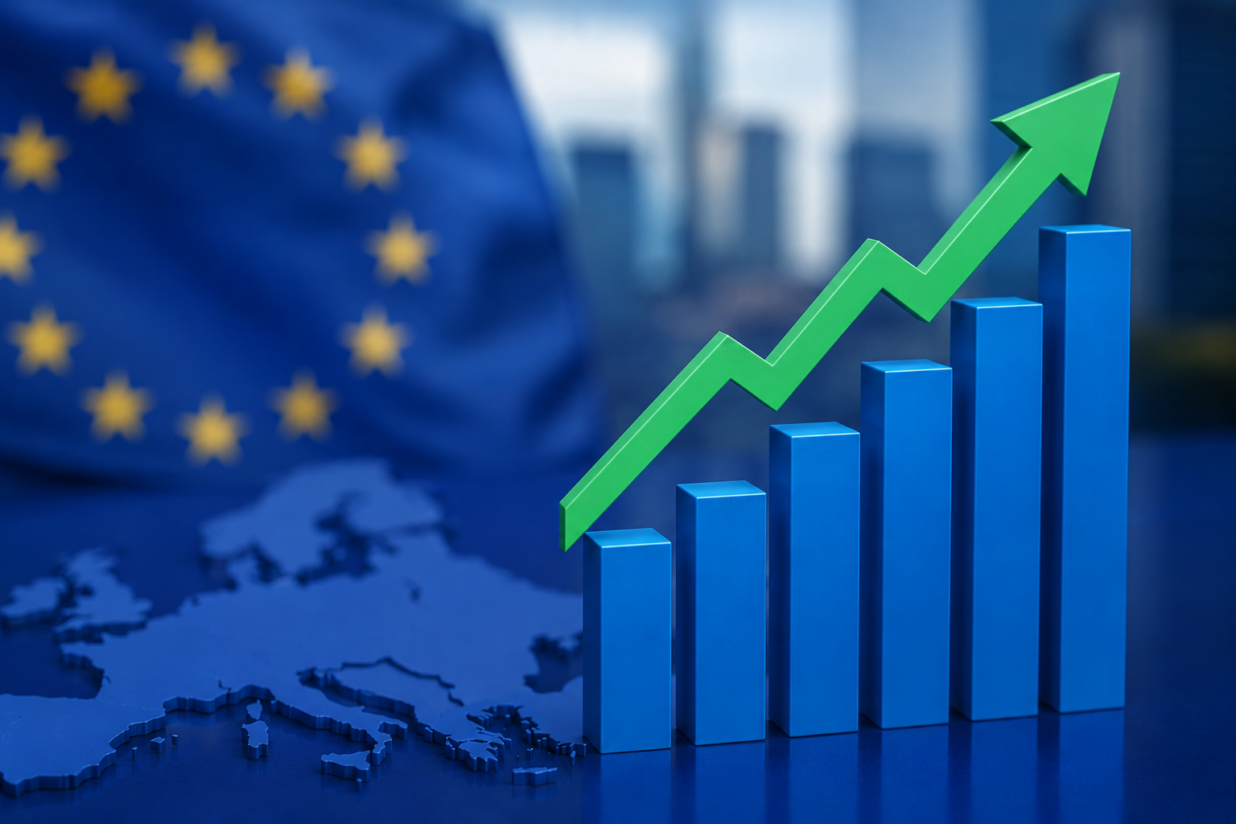
Eurozone business activity growth accelerated in August, providing more evidence that the region’s economy is resilient in the face of geopolitical tensions and ongoing economic uncertainties.
The S&P Global Flash Eurozone Composite PMI Output Index increased marginally to 52.1 in August, from 52.0 in July. The reading was also higher than the 51.7 predicted by economists in a Reuters survey.
A PMI rating above 50 implies that business activity is growing, whilst a reading below 50 indicates contraction.
The new data come after the eurozone economy expanded by 0.4% in the second quarter. The expansion indicates that the region’s economy has continued to develop despite geopolitical tensions and commercial pressures.
New orders provided one of the strongest signs. Demand surged at its quickest rate in 40 months, indicating better circumstances for businesses and higher commercial activity in the coming months.
EuroZone Business Activity Growth Gets a Boost From Manufacturing
Manufacturing was the primary driver of growth in August.
The eurozone factory PMI increased to 52.8 from 51.9 in July, the highest level in over four years. Manufacturing output also experienced its fastest growth in 54 months.
The development is noteworthy because manufacturers around the region have endured low demand and persistent pressure for a long time. According to the most recent data, companies are seeing increased orders, which might assist overall economic development.
Export demand also showed improvement. Export orders, including trade between eurozone nations, rose for the first time since Russia invaded Ukraine in February 2022.
According to Chris Williamson, chief business economist at S&P Global Market Intelligence, manufacturing has once again been the economy’s best-performing sector. He stated that the services sector continued to provide assistance following a challenging second quarter.
Services Sector Remains Stable
Services activity was stable in August. The services PMI remained at 51.7, unchanged from July.
The figure exceeded economists’ expectations, indicating that the services sector has sustained its upswing rather than losing momentum.
Employment Improves as Inflation Pressures Ease
The stronger business environment also improved employment.
Overall employment rose for the first time this year, as manufacturers resumed recruiting after more than three years of job cuts. Employment in the services sector also grew at its quickest rate in eight months.
Another encouraging sign was a drop in price pressures. The study revealed that inflationary pressures had reduced, providing some comfort to firms and individuals suffering increased costs.
However, the economic picture is uncertain.
The eurozone continues to suffer geopolitical threats, primarily from Middle Eastern crises. Higher energy prices and uncertainties about global trade may put pressure on firms in the coming months.
Germany Shows Modest Private-Sector Growth
Germany, Europe’s largest economy, saw modest private-sector growth in August.
The composite PMI was 51.0. However, the services sector continued to shrink, while manufacturing improved significantly.
Overall, the August PMI results are optimistic for the eurozone economy. Stronger new orders, increased manufacturing activity, higher employment, and lower pricing pressures all indicate to improved economic momentum.
Nonetheless, firms are vulnerable to geopolitical tensions, energy costs, and global trade uncertainty. These factors may have an impact on the strength of the recovery in the months ahead.