
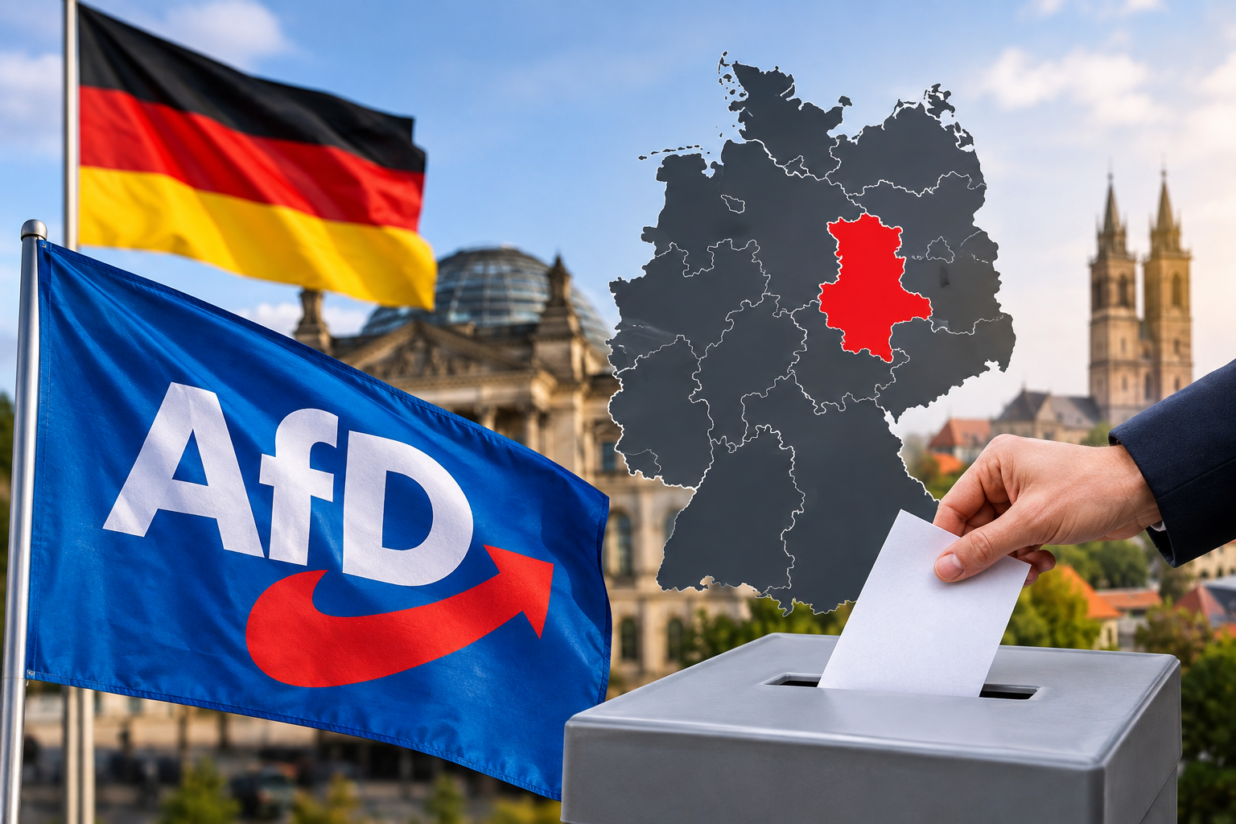
The AfD Saxony-Anhalt election 2026 is being closely watched as voters in the eastern German state head to the polls on Sunday. The far-right Alternative for Germany (AfD) has led opinion polls for months and could make history if it wins enough seats to form a government on its own.
Ulrich Siegmund, 35, leads the party in the state. Recent polls have the AfD slightly around 40%, far ahead of Chancellor Friedrich Merz’s Christian Democrats (CDU), which are polling at around 23%.
If many smaller parties do not receive at least 5% of the vote, the AfD may win an outright majority. Germany’s electoral system makes achieving a single-party majority difficult because seats are apportioned proportionally and coalition governments are prevalent.
AfD Saxony-Anhalt election 2026 could test Germany’s political firewall
A victory without the need for coalition partners would represent a significant breakthrough for the AfD. The “firewall” approach, in which mainstream German parties refuse to work with the party in power, has been in place for many years.
The state security office has designated the AfD as a “far-right extremist” organization. If it fails to gain an absolute majority, the firewall will make it difficult for the party to create a state government.
In that scenario, the CDU would most likely strive to maintain control under incumbent Premier Sven Schulze. However, depending on which smaller parties cross the 5% barrier, the outcome may result in difficult coalition discussions.
What happens if the AfD falls short of a majority?
Several parties are concerned about whether they will receive enough votes to enter the state parliament. The FDP, the CDU’s current coalition partner, is polling below the necessary level, while the SPD is polling under 10%.
The small, left-wing BSW is likewise projected to have difficulty crossing the threshold. It is the only party that hasn’t ruled out collaborating with the AFD.
According to polls, Schulze remains the top candidate for state premier. A coalition of the CDU, SPD, and Greens may not have enough seats, and the CDU has ruled out collaborating with the far-left Left Party.
Another possibility could be a minority government led by Schulze. Such a government could rely on the Left Party to tolerate it without formally joining the administration, similar to an arrangement previously used in neighbouring Thuringia.
AfD sees state election as a step toward national power
For the AfD, the vote is about more than just gaining power of Saxony-Anhalt. The party sees the state election as part of a larger drive to gain national power in Germany’s 2029 federal elections.
At a last campaign event in Magdeburg on Saturday evening, Siegmund stated that the party had already achieved history, regardless of the outcome on Sunday. He warned supporters that the political movement he sees sweeping across Germany could no longer be halted.
The conclusion will also serve as a test for Merz’s government. The chancellor has taken a stronger stance on migration and security in an attempt to decrease the AfD’s appeal, but the party’s strong polling figures demonstrate that it is still a major force in eastern Germany.
Polling stations will close on Sunday evening, with the first results expected at around 6 p.m. local time, or 1600 GMT.
- Join our whatsapp channel for daily updates.
- Follow tazatimesnews Telegram Channel for latest news alerts.
- Follow TazaTimesNews on TruthSocial for exclusive updates
- Also reads : UP TET Result 2026 Released: Check Scorecard and Qualifying Marks