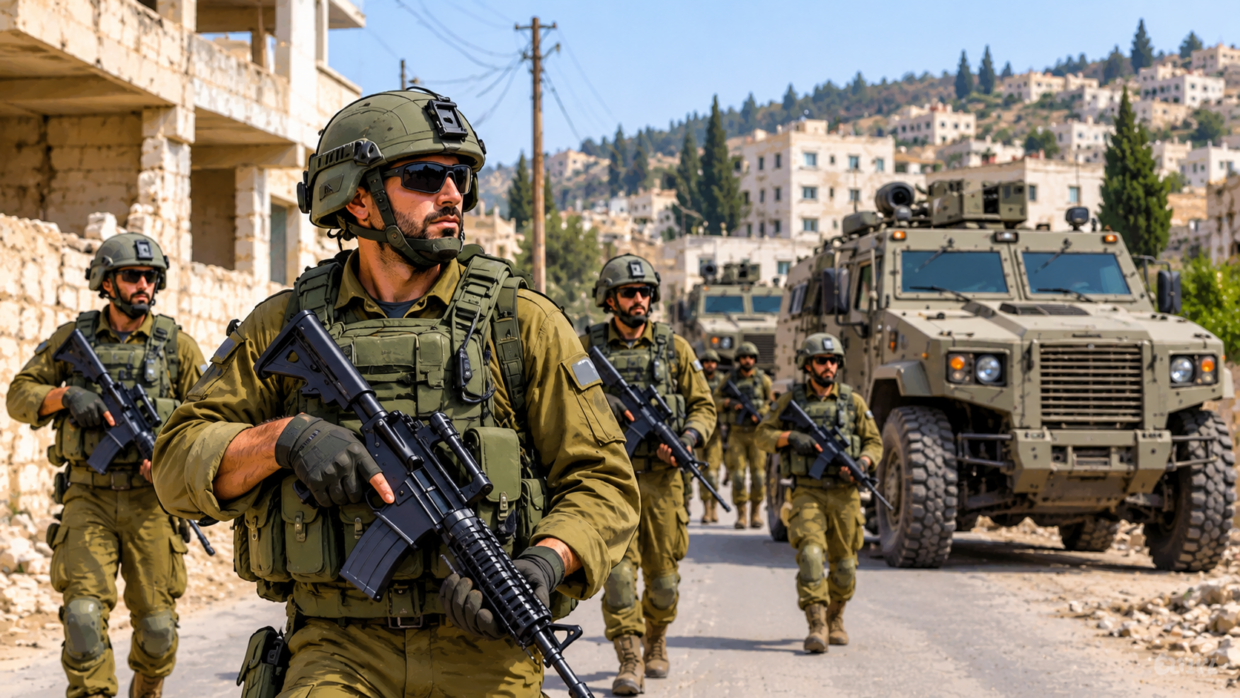
Israeli Forces in Quneitra : Israeli troops captured two persons during a military operation in Jabata al-Khashab, southern Syria, after invading civilian areas, raiding houses, and destroying local stores. The event occurred on November 13 in the northern countryside of Quneitra, where military operations continues to impact people and agricultural areas.
More than nine Israeli military vehicles entered the town during the operation. Soldiers inspected multiple homes and originally detained three persons. One of them was eventually freed, leaving two in detention.
The military also broke open numerous establishments’ doors and destroyed their storefronts. The event resulted in significant losses for local company owners.
The current operation comes as reports continue to emerge of Israeli military activities, temporary roadblocks, and arrests throughout Quneitra province. Agricultural activity have also been hampered by limits on cropland and grazing areas.
Israeli Forces in Quneitra Face Fresh Questions Over Raids
According to the Quneitra Media Directorate’s monthly report, there were 125 Israeli military incursions and 55 temporary roadblocks around the province in October. It also included a list of seven persons who remained in Israeli detention after being arrested that month. An further 23 persons were held before being released.
The paper emphasized the impact of military actions on agriculture and animal production. Israeli soldiers denied access to grazing pasture, used bulldozers to destroy agricultural areas, and damaged farmer and cattle facilities.
Water pumps and livestock infrastructure were among the things damaged. Israeli military also resumed earthworks in a woodland near Jabata al-Khashab. Artillery bombardment has been recorded in several agricultural regions around the province.
Approximately 300 olive trees were uprooted at Saida al-Hanout and the surrounding region. These activities, together with limitations on farmers and herders, have exacerbated the hardships that rural people confront.
Residents of Rweihena reported that Israeli soldiers had taken control of 5,000 to 6,000 dunams of farms and grazing grounds. Military restrictions and the establishment of outposts have also driven cattle herders to pursue perilous alternate routes. As a result, local dairy output has dropped dramatically.
Israeli Forces in Quneitra Draw Wider Attention
The recent detaining operation follows a number of prior events throughout the province. On October 31, Israeli soldiers apprehended five people while conducting operations along the route between Ofania and Khan Arnabah, as well as in the village of al-Hurriya. Four of those detained were gathering olives when troops set up a roadblock along the route.
Another incident occurred on October 23, when Israeli troops apprehended a guy grazing sheep near Hader.
Human rights organizations have also emphasized the scope of military engagement. The Syrian Network for Human Rights recorded at least 453 Israeli ground incursions between December 2024 and October 6, 2026. The organization claims that these actions resulted in at least 69 fatalities and 162 incidents of arbitrary detention.
Separately, the UN Human Rights Office documented over 280 Israeli military incursions in September alone.
Israel has justified its increased presence in southern Syria on security grounds. Prime Minister Benjamin Netanyahu has advocated for buffer zones and key military posts along the border.
Damascus has opposed the activities, citing infringement of Syrian sovereignty and the 1974 Disengagement Agreement. The Syrian government has demanded that Israeli soldiers leave its land and asked the international community to take action.
Conclusion
The recent Israeli operation in Quneitra underscores the ongoing hardships that people confront in southern Syria. Two persons remain arrested as a result of the November 13 raid, while damage to houses, stores, and agricultural supplies has exacerbated local challenges. According to reports from the province, military invasions, roadblocks, and restrictions have impacted farmers, livestock owners, and other inhabitants. The numbers supplied by the Syrian Network for Human Rights and the UN Human Rights Office also indicate a larger scope of recorded military operations. Israel argues that its presence is necessary for security reasons, while Damascus continues to demand a withdrawal and respect for Syrian sovereignty and the 1974 accord. The issue continues to be a serious worry in towns across the province.
- Follow TazaTimesNews on TruthSocial for exclusive updates
- Also Read : Gadi Eisenkot Gets First Chance to Form Israel’s Next Government