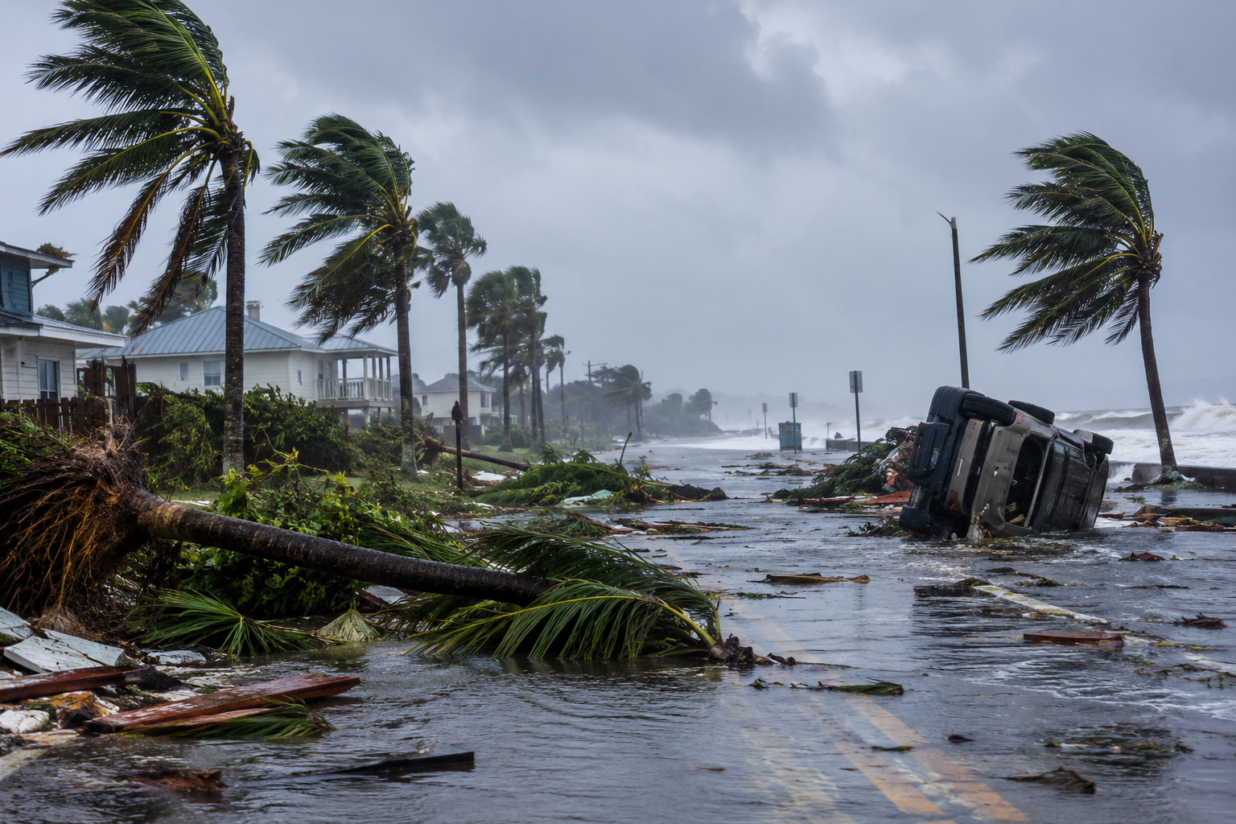
Cyclone Isaias has left at least four people dead after striking Florida’s Gulf Coast, with dangerous flooding, damaged homes and widespread power outages reported across parts of the southern United States.The storm weakened after hitting the coast late Friday, but officials cautioned Saturday that heavy rain and other risks would continue as it travelled inland.
The National storm Center (NHC) reported that Isaias made landfall near Destin, Florida, as a Category 2 storm with sustained winds of 105 miles per hour (165 kilometres per hour). It deteriorated overnight and moved northward as a posttropical cyclone.
The reported deaths included two people killed when trees fell on homes, one near Pensacola, Florida, and another in Birmingham, Alabama. A separate death in Florida involved a man found in a garage where a generator was running.
Cyclone Isaias Causes Damage and Power Cuts
The storm caused noticeable damage throughout affected regions, including fallen trees, damaged roofs, flipped automobiles, and power lines that were knocked down by powerful winds. According to the PowerOutage.com tracker, over 500,000 electrical customers in Florida, Alabama, and Georgia lost power Saturday nite.
Matt Howard, a resident of Mary Esther in Destin, reported that his home lost power and that a neighbour’s metal shed landed in his property. He stated that his family sought refuge in the center of their home and was fortunate that the storm passed through before reaching the region.
Authorities ordered mandatory evacuations ahead of the storm, so coastal streets were mainly vacant. Despite the storm’s diminishing, Florida Gov. Ron DeSantis warned citizens to exercise caution.
DeSantis warned that standing water and downed power wires might be dangerous. He also warned residents not to use generators inside their houses or garages, following the reported death of a man discovered with a generator operating in the garage.
On Saturday, the United States Department of Energy allowed the release of up to four million barrels of crude oil from reserves. The measure was meant to assist reduce the storm’s impact on the Gulf Coast, a major hub for the country’s oil refining industry.
Cyclone Isaias Raises Flood Concerns Inland
As Isaias travelled north, the risk expanded beyond coastal areas. The National Hurricane Center warned that certain areas might receive more than 10 inches (25 cm) of rain, raising the threat of flash floods and landslides.
Parts of the Southern Appalachians were especially concerned. North Carolina’s mountain villages were still recuperating from Hurricane Helene, which hit the same Florida region in 2024 before coming inland and dumping record rainfall in the mountains. That storm resulted in fatal floods.
Isaias’ arrival highlighted the importance of El Niño on Atlantic hurricane activity. The meteorological phenomena can enhance vertical wind shear over the Atlantic, making it difficult for storms to form or retain strength.
According to Michael Fischer of the University of Miami’s Rosenstiel School of Marine, Atmospheric, and Earth Science, this year’s wind shear in the Atlantic was practically record-breaking, indicating a severe El Niño.
The Pacific can have the reverse effect, with weaker wind shear allowing storms to intensify. Meanwhile, Mexico’s Baja California and the neighbouring US state of California were bracing for Tropical Storm Rachel, which was due to make landfall late Saturday, as Hurricane Simon caused devastation along Mexico’s western coast.
Although Isaias weakened after reaching Florida, communities along its path were still concerned about floods, dangerous debris, and power-related mishaps.
- Join our whatsapp channel for daily updates.
- Follow tazatimesnews Telegram Channel for latest news alerts.
- Follow TazaTimesNews on TruthSocial for exclusive updates
- Also read : Trump Picks Katie Zacharia for White House Press Secretary Role: Report