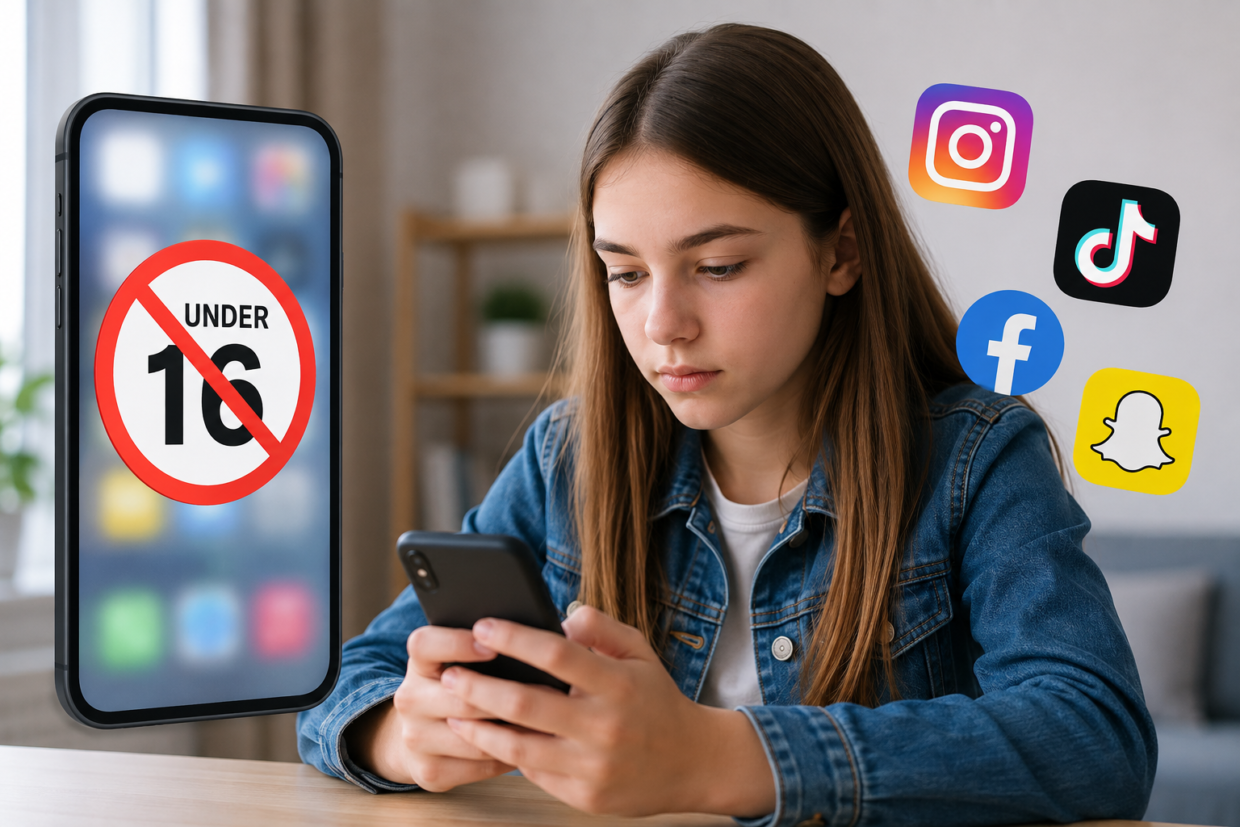
Australia Under-16 Social Media Ban: Australia’s world-first Under-16 Social Media Ban is raising new concerns about its effectiveness, with big technology businesses urging MPs not to draw conclusions based on preliminary evidence. Representatives from Google, Meta, Snapchat, and TikTok spoke before a Senate committee on Friday, August 14, to assess the effectiveness of the prohibition and whether more enforcement capabilities are required.
The Australian government imposed the ban in December 2025, prohibiting children under the age of 16 from having accounts on major social media platforms. The measure was created to limit young people’s exposure to hazardous information, addictive platform features, and algorithm-based suggestions.
However, preliminary findings indicate that many Australian youngsters under the age of 16 continue to use social media platforms. According to certain surveys, the vast majority of minors may continue to use these platforms despite the prohibitions, putting more pressure on the government to enhance enforcement and expand regulatory authorities.
Australia Under-16 Social Media Ban Faces Questions Over Early Results
Technology companies told the Senate panel that the current data should be taken with caution because the enforcement process is constantly evolving.
Rachel Lord, Google’s head of government relations, stated that it was too early to depend significantly on existing data. She also discussed the challenges of age-assurance technology, stating that systems designed to identify persons around the age of 16 are still evolving.
Mia Garlick, Meta’s Australia head of public policy, made another crucial point. She stated that research showing young people using social media does not necessarily imply that they own or operate accounts. Some participants may report using a platform while seeing content from a family member’s or another person’s account.
The corporations also provided updated numbers for actions taken against suspected underage users.
Meta said it has terminated around 756,000 Facebook and Instagram accounts that were thought to belong to Australian users under the age of 16. This was a huge increase from the approximately 500,000 accounts recorded in March.
Google stated that it had stopped approximately 740,000 Google account members from using their credentials to view YouTube.
TikTok reported that it erased roughly 550,000 accounts when the law first went into force, and it has continued to remove approximately 24,000 accounts every month since then.
Australia Under-16 Social Media Ban Could Lead to Tougher Penalties
The Senate inquiry is also reviewing recommended measures that might increase pressure on technology companies. The revisions would boost the maximum penalty for noncompliance to A$99 million and give Australia’s eSafety Commissioner greater authority to request information and documentation from social media platforms and third-party age-assurance providers.
The government’s approach is predicated on the idea that platforms, rather than children or parents, should be held accountable for enforcing the minimum age requirement. The rules in Australia allow corporations to utilize a variety of age-assurance procedures, including age inference, age estimation, and age verification.
The discussion currently revolves on whether the early evidence indicates a policy failure or just reflects the complexities of adopting a large new digital law.
The eSafety Commissioner is set to testify before the committee, where MPs will likely request additional information on compliance measures and potential enforcement proceedings.
Australia’s experiment is being closely observed throughout the world because it is one of the most aggressive initiatives by a government to limit young teenagers’ access to social media. The conclusion could have an impact on how other governments approach internet safety, age verification, and the roles of technology corporations.
- Join our whatsapp channel for daily updates.
- Follow tazatimesnews Telegram Channel for latest news alerts.
- Follow TazaTimesNews on TruthSocial for exclusive updates
- Also reads : Government Scheme: Post Office RD Can Help You Build a Corpus of Over Rs 16 Lakh