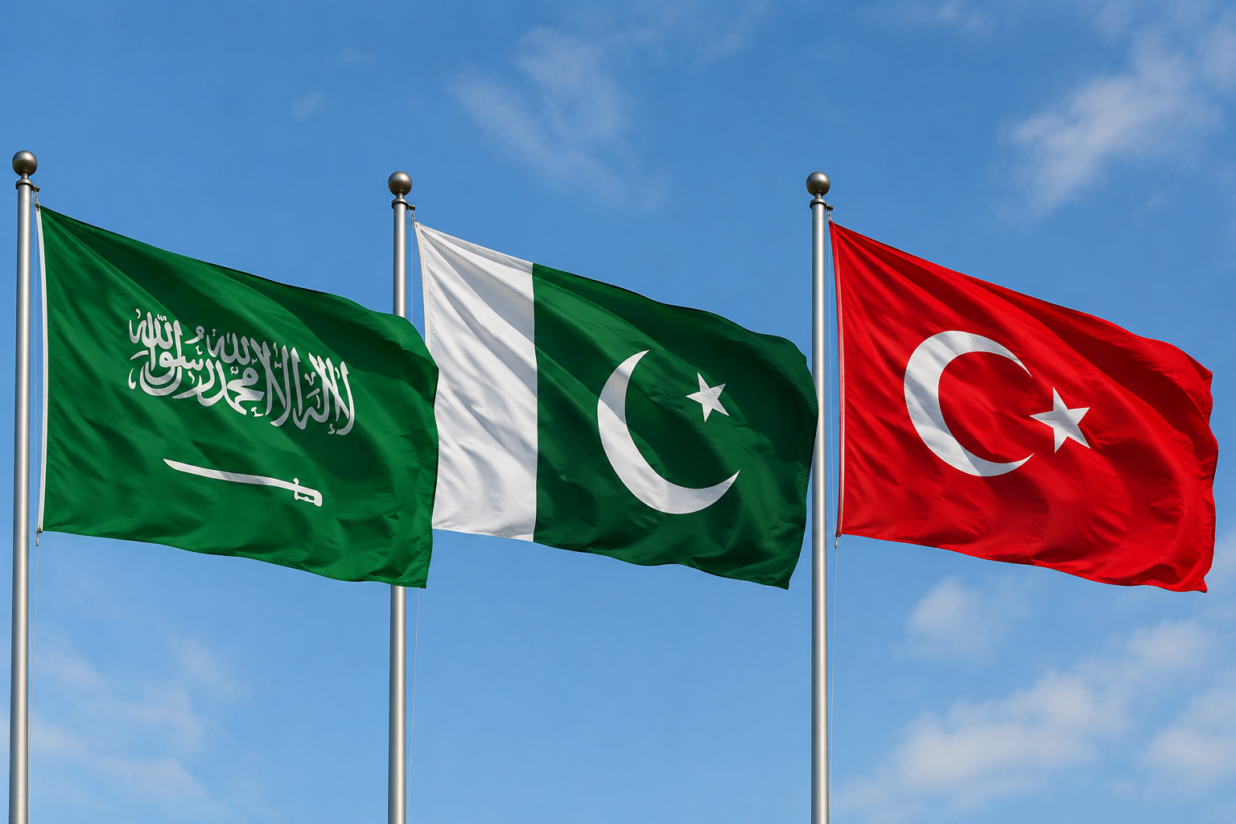
Saudi Arabia, Pakistan, and Turkey signed a new defense deal in Makkah, strengthening their security collaboration as three prominent Muslim-majority countries. The Makkah Joint Defense Agreement, signed on August 7, 2026, features a collective defense provision that treats an armed attack on one member as an attack on all three.
Saudi Crown Prince Mohammed bin Salman, Turkish President Recep Tayyip Erdogan, and Pakistan’s Prime Minister Shehbaz Sharif all signed the pact. The development occurs at a time when tensions in the Middle East remain high, and some regional governments are reconsidering their security strategy.
Saudi Arabia has stated that the pact aims to increase defense cooperation and improve coordination among the three countries. Officials have also stated that the deal does not establish a religious or military bloc and would not supplant current foreign partnerships.
Makkah Joint Defence Agreement Strengthens Three-Way Security Cooperation
The Makkah Joint Defense Agreement is deemed noteworthy since each of the three countries contributes unique strategic characteristics to the alliance.
Pakistan’s military is large and experienced, and the country possesses nuclear weapons. Turkey has a rapidly increasing defense sector, which includes modern drone and military technology capabilities, and is a NATO member. Saudi Arabia supplies significant financial resources and is still one of the Gulf region’s most powerful military and economic forces.
Because of these complimentary characteristics, the agreement might pave the way for improved military coordination, defense production, technology collaboration, intelligence sharing, and cooperative strategic planning. However, the agreement’s entire military duties have yet to be made public.
The timing of the agreement is also significant. The Middle East remains unstable, with Iran, Israel, and other regional entities at the center. Saudi Arabia has dealt with security challenges from attacks in and around the region, while Turkey and Pakistan have their own strategic interests in West Asia.
The pact formalizes the three countries’ long-standing security cooperation and adds another vehicle for responding collectively to future threats.
Makkah Joint Defence Agreement Puts India on Strategic Watch
India is expected to closely monitor the Makkah Joint Defense Agreement due of its long-standing strategic worries about Pakistan and the wider Gulf area. New Delhi has strong economic, energy, and diplomatic links with Saudi Arabia, but its relationships with Turkey and Pakistan have been more difficult.
The new agreement could gain significance if the three countries expand their collaboration beyond the existing framework. Indian authorities will likely keep an eye on whether the pact results in more intelligence sharing, joint military exercises, defense technology collaboration, or coordinated positions on regional security concerns.
At the same time, the agreement does not necessarily imply that Saudi Arabia, Pakistan, and Turkey will operate as a united military force. Analysts observe that the three countries continue to have divergent foreign-policy priorities and regional interests. The agreement’s practical significance will be determined by how its collective-defence clause is read and executed during an actual crisis.
For Saudi Arabia, the pact adds a new dimension of strategic partnership. It boosts Pakistan’s relationship with two important regional powers. Turkey expands its security partnership with Saudi Arabia and Pakistan.
For India, the immediate issue is not necessarily the formation of a new military bloc, but rather how this collaboration would develop in the coming years. The Makkah Joint Defense Agreement has created a new dimension to the geopolitical balance in both West and South Asia, which New Delhi is likely to closely monitor.
- Join our whatsapp channel for daily updates.
- Follow tazatimesnews Telegram Channel for latest news alerts.
- Follow TazaTimesNews on TruthSocial for exclusive updates
- Also reads : FIFA Governance Crisis: Infantino and FIFA Show Unity After Emergency Stake Sale Meeting