
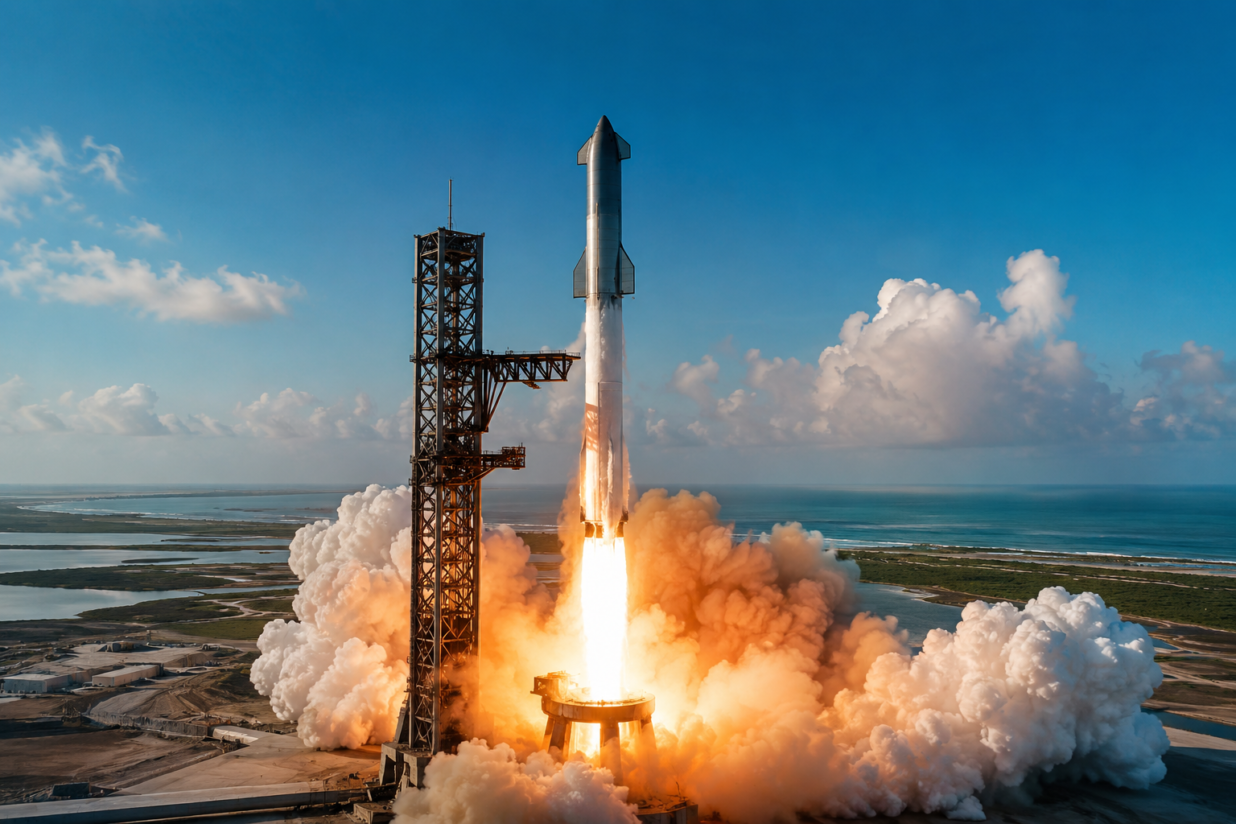
On July 24, SpaceX’s latest SpaceX Starship test mission successfully launched off from Starbase, Texas, marking another key milestone. The mission accomplished numerous major goals, including the first demonstration of enhanced Starlink satellite deployment and the restart of a Raptor engine in space. While the flight made great progress, engineers warn more testing is needed before Starship is ready for routine commercial and deep-space trips.
The 13th integrated test flight is another step toward SpaceX’s long-term goal of developing a fully reusable launch vehicle capable of transporting passengers and cargo to the Moon, Mars, and beyond. The mission also tested new technologies that may improve the company’s Starlink satellite network in the future.
SpaceX Starship Test Achieves Major Milestones
The SpaceX Starship rocket lifted up from the company’s Starbase facility in South Texas following earlier delays due to technical concerns. During the flight, SpaceX displayed the first deployment of 20 upgraded Starlink V3 satellites, which are intended to test next-generation internet capabilities.
The satellites were sent into suborbital space and briefly connected to the existing Starlink network. They were not meant to stay in orbit and instead re-entered Earth’s atmosphere, burning up as planned. This demonstration allowed engineers to test both the updated satellites and Starship’s payload deployment technology ahead of future operational missions.
Another notable accomplishment was the successful restart of one of the Starship’s Raptor engines while in space. This capacity is deemed necessary for future orbital maneuvers, satellite deployments, and deep-space missions. Engineers also gathered vital flight data to assist develop future iterations of the spacecraft.
SpaceX has spent years developing Starship, the centerpiece of its next-generation launch system. Once fully operational, the reusable rocket is projected to reduce launch costs while also supporting Starlink deployments, NASA missions, commercial payloads, and future human missions to Mars.
SpaceX Starship Continues Development Despite Challenges
Although the last SpaceX Starship flight hit numerous significant objectives, the program is still in the testing phase.
According to SpaceX, the Super Heavy rocket successfully finished its ascent and boostback burn. However, some engines failed to restart during the booster’s descent, resulting in a harder-than-planned splashdown in the Gulf of Mexico rather than a smooth landing.
Meanwhile, Starship continued along its planned flight path, successfully deployed the upgraded Starlink satellites, restarted a Raptor engine in space, and later completed a controlled splashdown in the Indian Ocean. The spacecraft also showed improved heat shield performance during atmospheric re-entry, providing engineers with valuable data for future missions.
SpaceX has improved Starship after each test by improving its engines, flight software, heat shield, and onboard systems. Each mission assists engineers in identifying necessary improvements before the rocket begins regular commercial operations.
NASA is closely monitoring Starship’s progress because a modified version of the spacecraft is expected to serve as the Human Landing System for the Artemis programme, which aims to return astronauts to the Moon. Starship is also expected to play a key role in expanding SpaceX’s Starlink network and supporting future missions to Mars.
SpaceX claims that each test flight offers useful engineering data, even if not all objectives are met flawlessly. The company’s quick testing approach remains unchanged, with each mission used to improve the vehicle before operational flights begin.
With the successful launch, upgraded Starlink deployment demonstration, in-space engine restart, and improved re-entry performance, the latest mission marks another significant step in Starship’s development. However, additional testing and refinements will still be needed before the world’s most powerful rocket is ready for routine commercial launches and future missions to the Moon and Mars.
Also reads
Trump Air Force One to Receive ‘Maxed Out’ Upgrades After Qatar Aircraft Deal