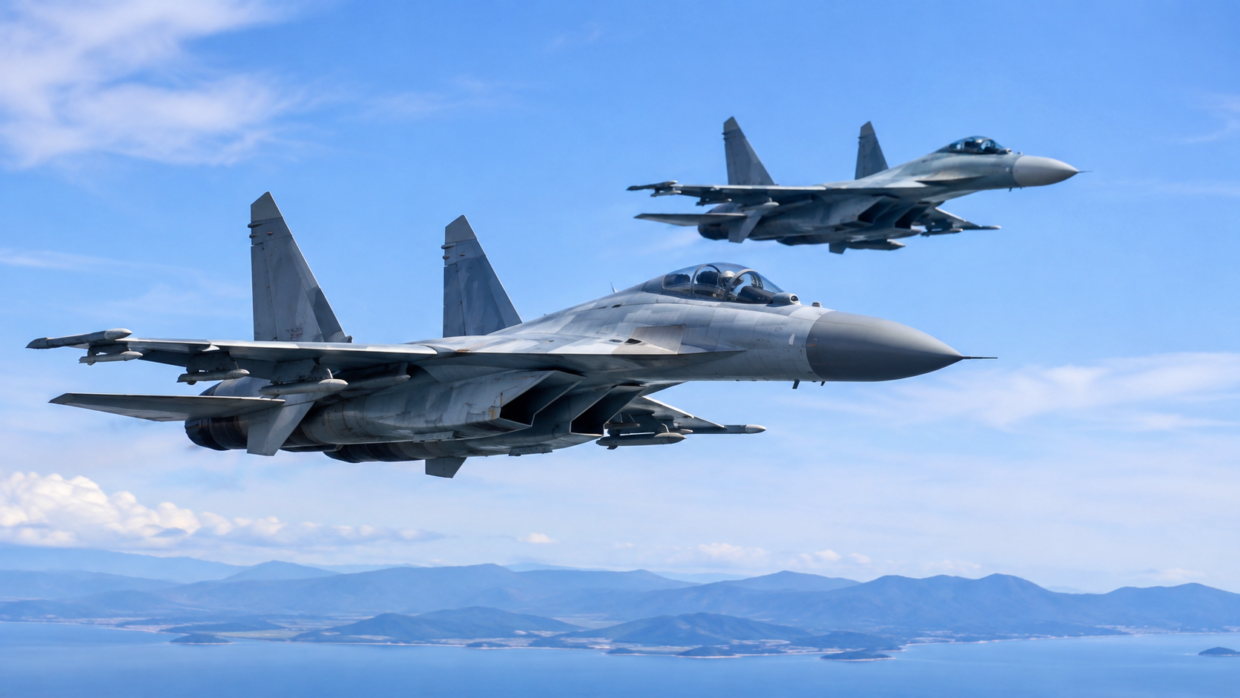
South Korea Deploys Fighter Jets After Russian Aircraft Enter Air Defence Zone : South Korea launched fighter planes on Tuesday after detecting multiple Russian defense identification zone (KADIZ) over the East Sea. The airplane eventually exited the zone without violating South Korean sovereign airspace.
The South Korean military kept an eye on the planes as they approached the designated identifying area. Fighter planes were dispatched into the air, and the Air Force took tactical precautions to prepare for any potential crisis.
The incident included Russian military planes flying over an area where South Korea monitors inbound aircraft for security reasons. However, Seoul stressed that the Russian jets did not enter its sovereign airspace.
Russian Aircraft Trigger South Korea’s Air Response
South Korea’s Joint Chiefs of Staff (JCS) reported that an undefined number of Russian military aircraft entered the Korea Air Defense Identification Zone in the early hours of Tuesday.
The planes were noticed before they entered the zone. This enabled the South Korean military to deploy fighter planes and take preventative measures while monitoring their movements.
In a short statement, the JCS stated that the military had identified the Russian jets ahead of time and had sent its Air Force fighters. It also stated that tactical measures were taken to be ready for any unforeseen events.
The aircraft ultimately evacuated the KADIZ, and South Korean authorities clarified that the incident did not include a trespass into the country’s sovereign airspace.
An air defense identification zone differs from a country’s national airspace. It is a zone where approaching aircraft are detected and tracked to ensure national security.
Military aircraft are normally expected to notify the appropriate government before entering such a zone. However, international law does not need previous notification.
This distinction is essential since entering an identification zone does not always imply that an aircraft has violated another country’s airspace.
Earlier China-Russia Flights Also Drew Seoul’s Attention
The newest incident comes after a similar event in June, when more than ten Chinese and Russian military aircraft breached South Korea’s air defense identification zone.
South Korea also replied by dispatching fighter planes at that time. The plane involved in the June incident did not enter South Korean national airspace.
China described the previous conduct as a coordinated strategic air patrol with Russia. Beijing stated that the operation spanned the Sea of Japan, the East China Sea, and the western Pacific Ocean.
It further said that the patrol aimed to promote regional peace and stability. China’s statement, however, made no particular mention of South Korea or its air defense identification zone.
The June operation comprised aircraft from both countries, but Tuesday’s alleged incident involved Russian military jets. Both incidents prompted South Korea to take preventive military actions.
Conclusion
South Korea’s most recent deployment of fighter planes demonstrates its response to foreign military aircraft approaching its air defense identification zone. The military noticed the Russian jets before they entered the region and implemented tactical steps to monitor the situation. However, the aircraft departed without breaching South Korean airspace.
The incident follows a similar air patrol involving Chinese and Russian aircraft in June, which led Seoul to deploy more fighter jets. While an air defense identification zone assists governments in tracking approaching aircraft, it is not synonymous with national airspace, and entering it does not constitute an airspace violation. South Korea’s statement confirmed that Tuesday’s event fell inside that category.
- Join our whatsapp channel for daily updates.
- Follow tazatimesnews Telegram Channel for latest news alerts.
- Follow TazaTimesNews on TruthSocial for exclusive updates
- Also Read : Israel Election Results: Netanyahu Faces Coalition Challenge as Rivals Weigh Arab Alliance