New Zealand Election : New Zealand’s freshly elected parliamentarians are prepared to enter parliament, but the country’s next administration remains unknown. The election results give the existing center-right coalition a slim advantage, however a considerable number of ballots are still being tabulated.
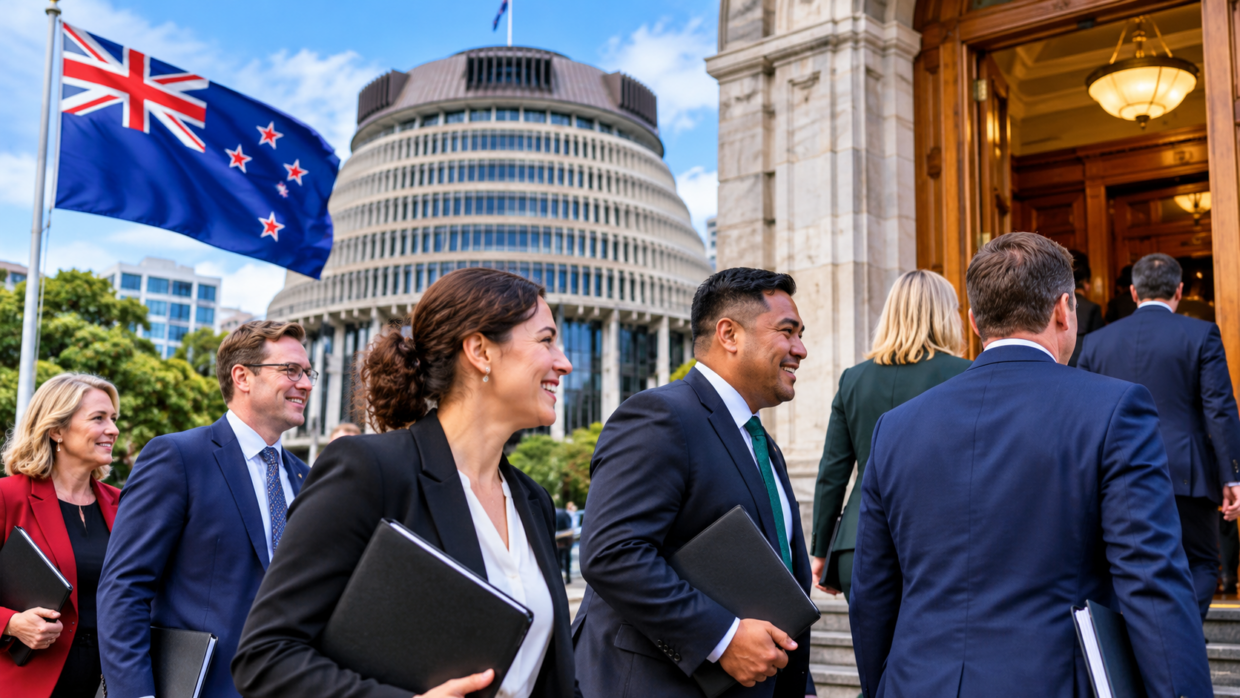
Dozens of new members of parliament are set to arrive in Wellington this week. Seven of them are members of the centrist Opportunity Party, which entered parliament for the first time after passing the 5% vote threshold.
The final election results may decide whether the present three-party alliance can govern on its own or need assistance from another party. Official results are not anticipated before November 27.
New Zealand Election Leaves Coalition Numbers Uncertain
In the 131-member parliament, Prime Minister Christopher Luxon’s National Party, ACT New Zealand, and New Zealand First possess a combined 67 seats, according to preliminary results. A majority requires 66 MPs in total, and the alliance is only one seat above that threshold.
But it’s not a comprehensive count. There are still about 400,000 uncounted ballots, or nearly 15% of the total. Thus, the balance between the major parties might be altered by the final numbers.
Luxon and Chris Hipkins, the head of the Labor Party, have both stated that formal coalition discussions would not begin until the official outcome is known. This implies that the nation could not know which group would form the next administration for several weeks.
Nationally, Labor just outnumbered National in the number of votes. Nevertheless, in the early seat count, National secured enough electorate seats to maintain its three-party alliance’s lead.
Additionally, the election gave minor parties a better showing. Support expanded across the political spectrum as voters shifted away from the two biggest political parties. The election brought attention to a number of issues, including a failing economy, rising living expenses, and healthcare issues.
New Zealand Election Puts Opportunity Party in Focus
If the final count differs from the present figures, the Opportunity Party may gain traction. Its leader, Qiulae Wong, is a political newbie, and her party’s seven MPs are gearing up for their maiden stint in parliament.
Wong stated that her caucus is gathering in Wellington to make preparations. She’s also gotten calls from Hipkins and Green Party co-leader Chloe Swarbrick. However, she stated unequivocally that no official conversations had begun.
Luxon also stated that he intended to contact Wong soon. As political leaders await final data, the potential influence of the Opportunity Party has emerged as a significant question.
Investors are paying attention to the uncertainties as well. The New Zealand currency, as well as the potential direction of government expenditure and fiscal policy, have dominated market attention.
Kelly Eckhold, chief economist at Westpac Bank in New Zealand, warned markets might remain volatile for the next several weeks while the outcome is determined. He stated that the currency rate will be a key emphasis.
Eckhold predicts a center-right administration. However, he stated that a crucial question is whether the government would require assistance from the Opportunity Party, as well as what conditions may be required to strike an agreement.
The finance portfolio is another problem that the new administration must address. On Saturday nite, New Zealand Finance Minister Nicola Willis lost her seat. According to Brad Olsen, chief economist at Infometrics, the immediate question is who will serve as the new finance minister.
Conclusion
The center-right coalition has a tiny lead in New Zealand’s election, but the ultimate conclusion will not be known until all remaining ballots are tabulated. The official results, which are due on November 27, will offer a more accurate picture of the power balance. Until then, the National Party, ACT New Zealand, and New Zealand First cannot be guaranteed that their existing majority will continue. The Opportunity Party may possibly play a role if the numbers shift, though no official coalition talks have commenced. Investors are keeping a close eye on the process, particularly the currency and future budgetary direction. Following Nicola Willis’ defeat in the election, the future government will require a new finance minister.
- Join our whatsapp channel for daily updates.
- Follow tazatimesnews Telegram Channel for latest news alerts.
- Follow TazaTimesNews on TruthSocial for exclusive updates
- Also Read : Gadi Eisenkot Gets First Chance to Form Israel’s Next Government