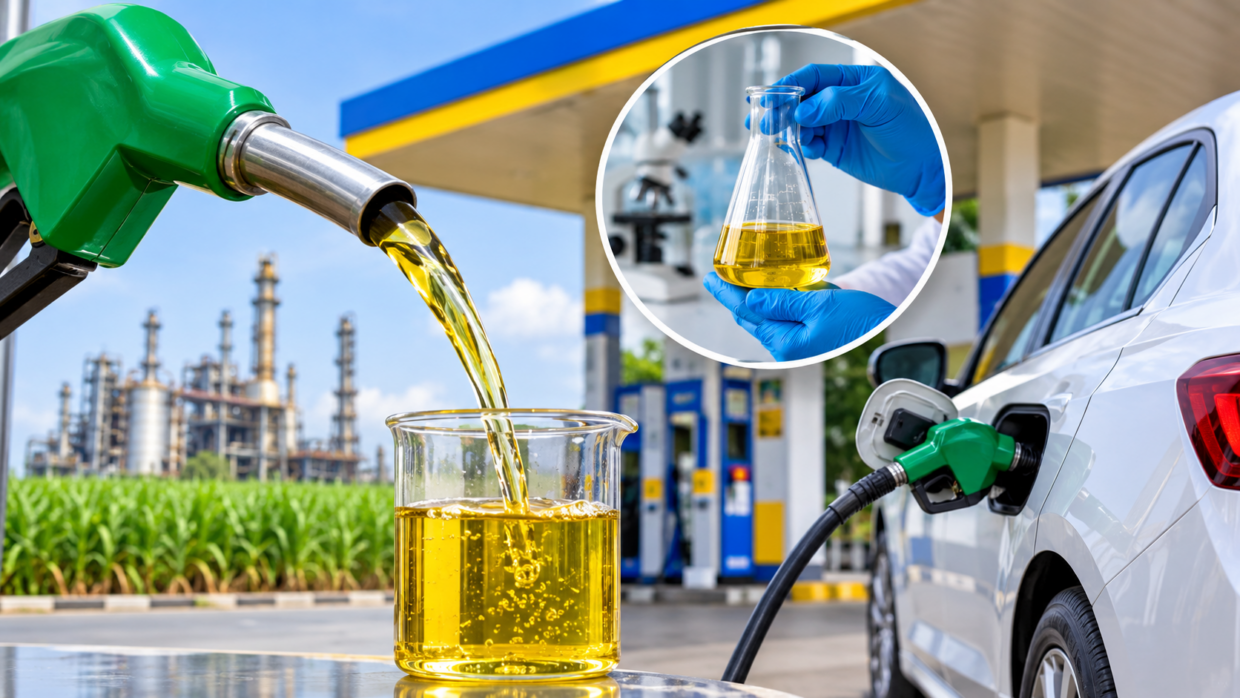
E20 Petrol Row : India’s three major public-sector oil corporations have denied Karnataka’s assertion that fuel sold at some retail outlets included ethanol levels as high as 26% to 31%. Indian Oil Corporation Limited (IOCL), Bharat Petroleum Corporation Limited (BPCL), and Hindustan Petroleum Corporation Limited (HPCL) claim their national quality tests revealed ethanol blending within the permissible range.
The corporations have also questioned how Karnataka gathered and evaluated fuel samples during an exercise held in October. They have urged the state administration to provide all laboratory reports and sample data so that the results may be independently verified.
The controversy revolves upon the ethanol percentage in E20 gasoline and the testing procedure used to determine whether the fuel satisfied the statutory specifications.
E20 Petrol Row: Oil Companies Share Test Results
The three oil marketing corporations stated that they evaluated 893 petrol samples taken from 27 states and union territories. Their combined findings revealed that each sample contained an ethanol concentration of 19% to 21%, which they regarded as being within the approved range.
The findings also included 56 samples obtained in Karnataka. These samples showed ethanol levels ranging from 19% to 20%, with an average of 19.30%.
The firms stated the data did not back up the alleged assertion that fuel at specific Karnataka shops contained 26% to 31% ethanol. In their joint statement, they stated that the alleged assertions were not supported by tests conducted in accordance with the approved legislative and technical processes.
However, the oil firms’ complaints were not limited to the published statistics. They also questioned how the samples were gathered and analyzed during Karnataka’s October testing session.
According to the corporations, samples were obtained without the presence of oil marketing firm staff. They also questioned the choice to engage a third-party laboratory rather than one specified under the appropriate Control Order.
Another worry was the information contained in the laboratory certifications. The firms stated that the available technical information did not allow them to independently verify the ethanol levels cited in the reports.
E20 Petrol Row: Mileage Loss and Repair Claims Disputed
The oil corporations have also questioned the financial calculations related to the ethanol blending problem. The claims included Rs 62,000 crore in customer mileage losses and Rs 39,000 crore in car maintenance charges. These estimates come to Rs 1.01 lakh crore.
In response, the businesses cited technical studies that showed varying amounts of mileage impact among automobiles. These investigations found losses ranging from 3% to 6% in several other automobiles. The stated mileage impact for cars calibrated for E20 gasoline was smaller, ranging between 1% and 2%.
As a result, the values mentioned by the firms diverge from the greater financial projections presented in the dispute. However, the presented data does not allow for a final independent assessment of overall customer losses or repair costs.
To address the dispute, IOCL, BPCL, and HPCL have demanded all laboratory findings, sampling data, and counterpart samples from Karnataka. They want the substance tested by an authorized laboratory using the prescribed methods.
Conclusion
The E20 Petrol Row revolves around two important issues: the actual ethanol percentage of the tested fuel and whether the sampling and laboratory processes met the acceptable criteria. Karnataka’s claimed findings indicated greater blending levels at select locations, whilst the three oil firms’ assessments showed levels ranging from 19% to 21%. Their Karnataka samples showed an average of 19.30%. The corporations have questioned the testing procedure, as well as the cost estimations for mileage loss and car repairs. They have now requested full records and samples for independent verification. They have also indicated that any variations discovered using the specified testing procedures would be handled in accordance with the relevant rules. The final evaluation will be based on the analysis of the requested evidence using the approved method.
- Join our whatsapp channel for daily updates.
- Follow tazatimesnews Telegram Channel for latest news alerts.
- Follow TazaTimesNews on TruthSocial for exclusive updates
- Also reads : Trump Africell Loan: US Plans $100 Million Telecom Deal to Counter Huawei in Africa