
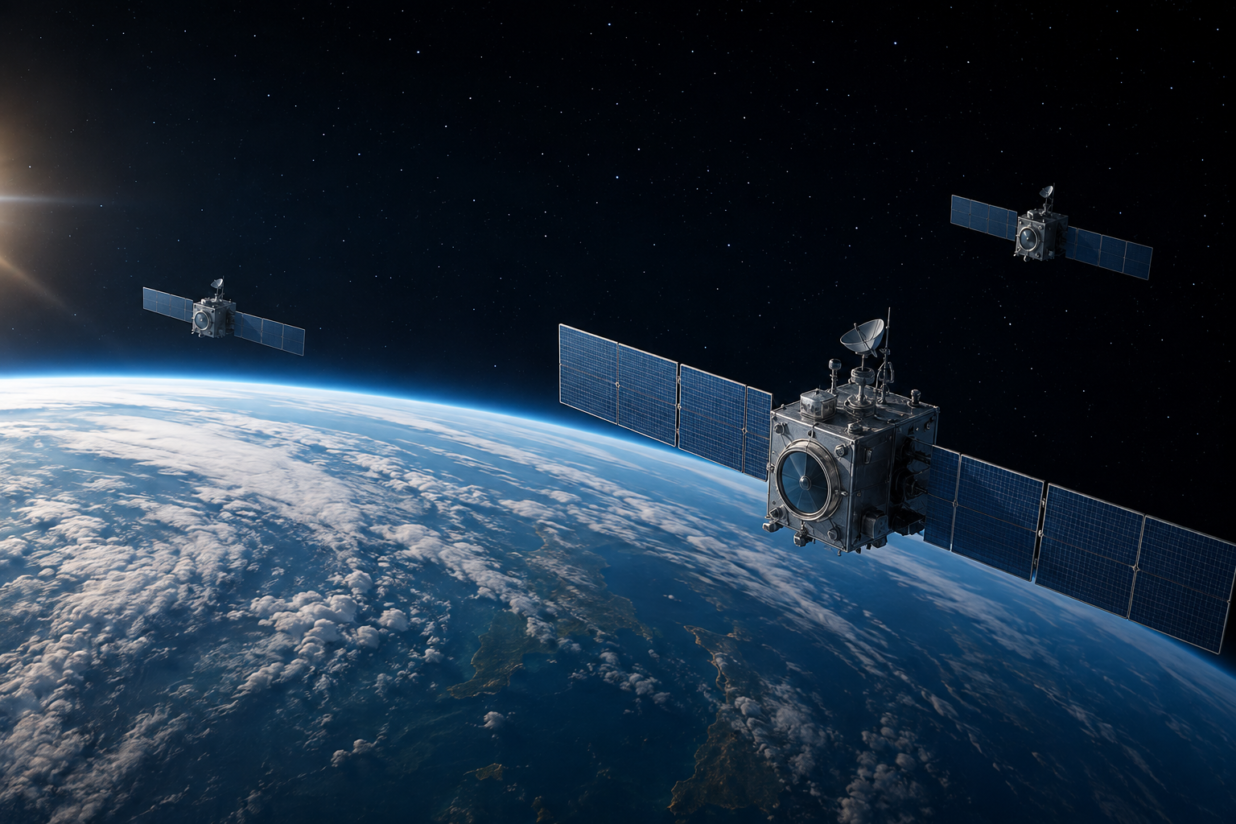
Space Security Milestone : New Zealand space operators have participated in a major international exercise aimed at determining how quickly countries can notice and respond to a potential danger involving a commercial satellite. The US-led effort gathered together space experts from various countries to see how well they could collaborate while monitoring a simulated attack scenario in orbit.
The exercise was dubbed a Space Security Milestone because it focused on cooperation across different countries and time zones. Rather of relying on a single nation to monitor space activities, participant teams collaborated to provide continuous surveillance and share information about anomalous activity.
The incident also demonstrated the increasing importance of commercial satellites in modern civilization. Governments, military organizations, and corporations are increasingly reliant on privately owned spacecraft for communications, navigation, imaging, and other critical services. A disruption affecting these satellites could potentially have far-reaching ramifications for the space sector.
Simulated Space Attack Tests Coalition Response
The exercise involved a fictitious situation in which a spacecraft was viewed as a potential threat to a commercial satellite. However, the process extended beyond a computer-based simulation. A actual satellite maneuver was performed to provide participating operators a more practical test of their abilities to detect, monitor, and assess activity in orbit.
During the SALITRE 2026 exercise in Chile, US Space Forces-Southern headed the space operations cell. Personnel from the United States, Chile, Brazil, Colombia, NATO’s space community, South Korea, and New Zealand took part in the continuous monitoring mission.
One of the most notable characteristics of the exercise was its multinational, round-the-clock approach. Teams in several regions shared responsibility as their working hours changed. This resulted in a constant “follow-the-sun” monitoring system, allowing coalition members to keep an eye on the growing situation without relying on a single site.
The scenario featured Turion Space’s DROID-002 satellite. A simulated hostile spaceship was presented as approaching the commercial satellite. Turion then executed a true maneuver at more than 1 meter per second.
Coalition operators were tasked with detecting and assessing genuine movement while treating it as part of the fake threat scenario. This enabled teams to put their capacity to discern and respond to potentially substantial activity in space to the test in more realistic situations.
US Space Force Col. Brandon P. Alford hailed the drill as a watershed moment, emphasizing the need of international cooperation in space security. The combination of a simulated threat with a real orbital maneuver allowed participants to put their practical decision-making and coordinating skills to the test.
Space Security Milestone Highlights Growing Risks
The drill takes place at a time when satellites are becoming increasingly crucial for national security and daily life. Space-based systems are used for military operations, communications, weather forecasting, navigation, photography, and a variety of economic activities.
At the same time, the number of privately owned satellites in orbit continues to increase. This means that governments and international partners require effective methods for monitoring commercial spacecraft and responding to questionable conduct.
The coalition model used during the experiment could assist governments in developing a more complete picture of events in orbit. Sharing information across national borders may enable operators to detect potential risks earlier and cut delays when an unexpected situation arises.
Newer space operators benefited greatly from the practice as well. Four Chilean Air Force troops who had recently completed specialized training took part in real watch-floor operations. Their roles included finding satellites, monitoring space activity, and assisting the larger coalition operation.
International Cooperation Strengthens Space Security
The exercise showed how worldwide collaboration may increase the ability to monitor and defend space assets. Maintaining continuous coverage is especially crucial because activity in orbit does not cease when a country’s working day finishes.
The simulation also shown that superior technology is not enough to ensure effective space security. When responding to a possible danger, communication, information exchange, and coordination across borders are all critical.
Although the situation was fictitious, it mirrors growing concerns about the security of satellites and other space equipment. As commercial and government systems rely more on space-based services, the capacity to detect suspect activities and respond promptly becomes increasingly vital.
Lessons from the space operations cell are intended to be used to future multinational efforts, including PANAMAX 2026. The overarching goal is to build stronger and more compatible alliances that will enable governments to detect dangers, communicate information, and coordinate responses when commercial or government satellites are threatened.
The exercise thus constitutes a major Space Security Milestone, illustrating how countries may collaborate to maintain constant awareness and increase their ability to respond to emerging threats in orbit.
- Join our whatsapp channel for daily updates.
- Follow tazatimesnews Telegram Channel for latest news alerts.
- Follow TazaTimesNews on TruthSocial for exclusive updates
- Also reads : Goldman Sachs Says Japan Leads Asia’s Buyout Opportunities as Private Equity Activity Grows