
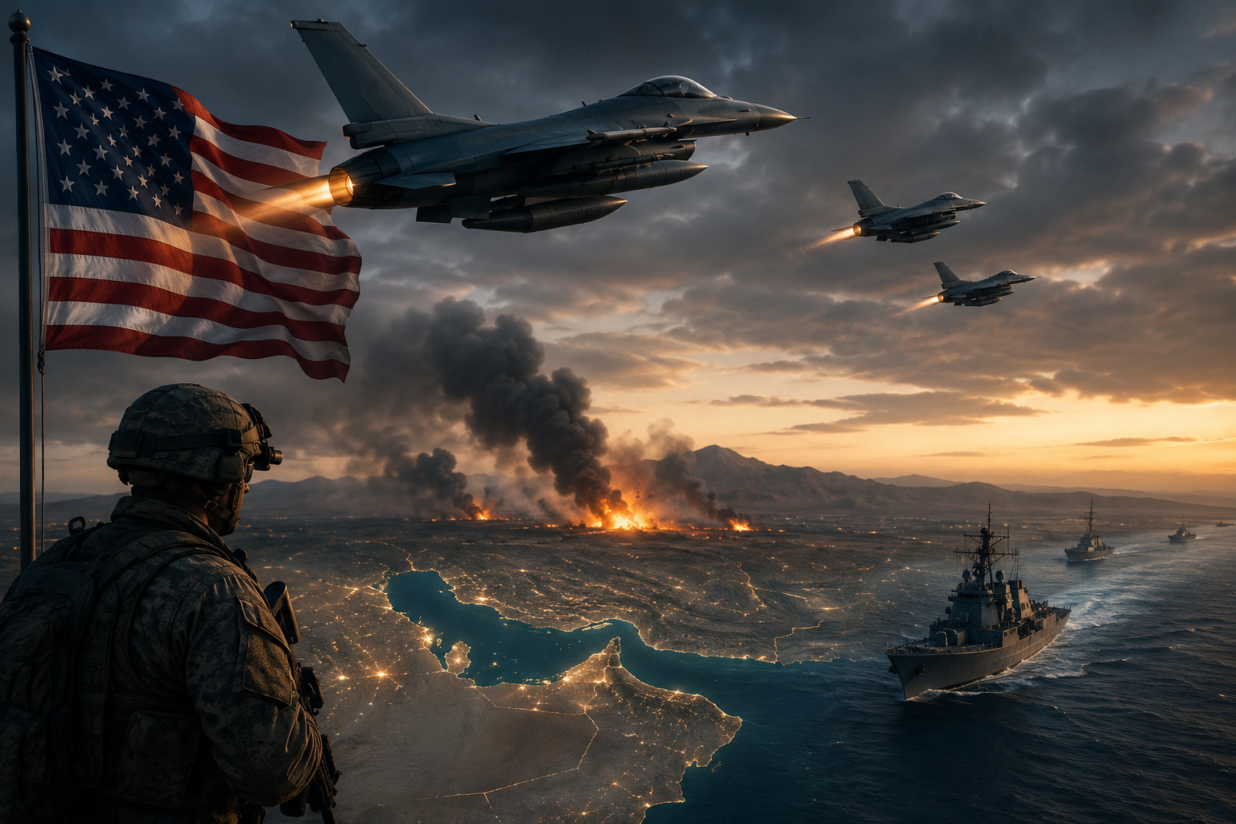
US-Iran Conflict :The US has maintained its military assault against Iran for the 13th night in a row, indicating that tensions between Washington and Tehran are far from ended. US officials claim the activities are intended to reduce regional security threats. However, the continued strikes have sparked new fears about Middle Eastern stability, global energy supply, and the security of international maritime routes.
According to the United States Central Command (CENTCOM), the most recent action lasted more than two hours and was carried out under President Donald Trump’s order. The military claimed the strikes targeted important Iranian military assets associated with missile, drone, and maritime capabilities.
US-Iran Conflict Intensifies After 13th Consecutive Night of Strikes
According to CENTCOM, the current operation targeted Iranian military command centers, drone storage facilities, communication networks, coastal surveillance locations, and marine capabilities. According to US officials, these facilities were utilized to support actions that could endanger commercial shipping and American military stationed in the area.
The operation is part of a larger US campaign intended at limiting Iran’s capacity to strike international maritime routes, particularly the Strait of Hormuz. The strategic waterway transports a large portion of the world’s oil exports, making it one of the most essential energy routes in the globe.
The new strikes came shortly after President Donald Trump threatened Iran and its Houthi allies with “major military punishment” for attacks on two Saudi oil tankers in the Red Sea. The warning has raised concerns that the crisis would expand wider throughout the Middle East.
Iran has repeatedly warned that attacks on its essential infrastructure may result in reprisal against regional oil, gas, electrical, and economic sectors. However, Tehran had no immediate official response to the second round of US operations.
Regional Security and Global Markets Remain on Alert
Security analysts feel that the continuation of daily military operations is growing uncertainty in the Middle East. Governments around the region are closely monitoring the situation, as concerns rise about potential disruptions to trade, energy supplies, and regional stability.
Financial markets are closely monitoring events. Any disruption to shipping through the Strait of Hormuz might have an impact on global oil prices, as a major amount of the world’s crude oil passes through the tiny waterway every day.
Several governments have encouraged both sides to avoid further escalation and resume diplomatic discussion. According to analysts, while military intervention may alleviate immediate security issues, a long-term solution will most likely require negotiations rather than ongoing conflict.
For the time being, the United States has stated that military activities will continue as long as Iranian capabilities are deemed a danger to regional security and international marine traffic. With the campaign now in its twelfth night, global attention is focused on whether diplomatic attempts can prevent the issue from escalating into a larger regional conflict.
Follow TazaTimesNews
- Join our whatsapp channel for daily updates.
- Follow tazatimesnews Telegram Channel for latest news alerts.
- Follow TazaTimesNews on TruthSocial for exclusive updates
Also reads
Trump Air Force One to Receive ‘Maxed Out’ Upgrades After Qatar Aircraft Deal