
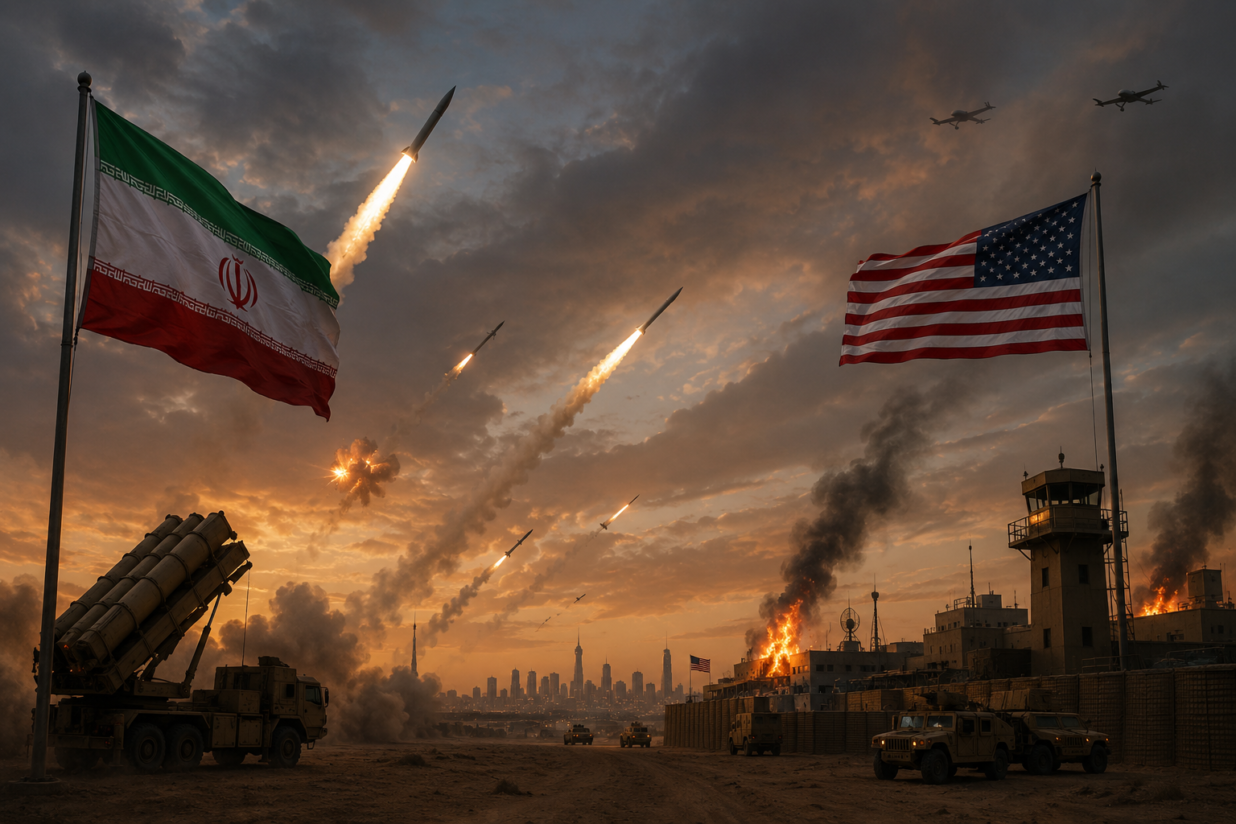
The Iran US conflict escalated sharply after Tehran launched missile and drone strikes targeting American military bases in Kuwait and Bahrain. The attacks came shortly after the United States carried out military operations against targets in Tehran, raising fresh concerns over a wider military confrontation across the Middle East.
According to Iranian sources, the operation began in retaliation to recent US attacks on Iranian land. Iran said that it had attacked military sites utilized by American soldiers in the Gulf region, describing the strikes as a defensive response to what it called continued aggression.
The Iranian military stated that various US-related facilities in Kuwait and Bahrain were among the targets. As rumors of explosions and air defense activity surfaced, authorities in both Gulf countries immediately implemented emergency security measures. Local officials advised locals to keep calm as security agents assessed the situation.
The US has not yet provided detailed information regarding the damage suffered by the attacks. However, American defense sources stated that US military stations in the Gulf region were attacked and that defensive systems had been engaged to intercept incoming missiles and drones. Initial evaluations revealed that numerous incoming bullets were intercepted, while investigations into the total impact and potential damage were ongoing.
Iran US Conflict Raises Regional Security Concerns
The most recent developments have raised concerns throughout the Middle East, where numerous countries host American military outposts. Security specialists worry that sustained military action might jeopardize regional peace, disrupt international shipping lines, and put additional pressure on global energy markets.
Iran’s leadership backed the operation, warning it would respond if future strikes were launched against the country. Iranian officials said that the strikes were intended to safeguard national sovereignty and send a strong message against future military aggression.
Meanwhile, Kuwait and Bahrain condemned the strikes on their territories and highlighted the importance of regional stability. Both governments strengthened military readiness while closely cooperating with allied partners to monitor the situation as it evolved.
International observers fear that any retaliation by either side could spark a larger regional confrontation including more Gulf countries. Diplomatic efforts by regional and global countries are expected to continue in an attempt to calm tensions and avert further escalation.
Iran US Conflict Could Impact Global Economy
Beyond the military confrontation, analysts believe the renewed Iran US conflict could have significant economic consequences. The Gulf region remains one of the world’s most important energy hubs, and any disruption to shipping routes or oil production could push global energy prices higher.
Financial markets are also keeping a careful eye on developments, with investors concerned that prolonged volatility will have an impact on international trade, transportation, and company confidence.
The United States says it is constantly watching the security situation and will continue to protect its personnel and strategic interests in the region. American authorities also warned that any subsequent attacks on US personnel will be met with a suitable response.
As tensions remain high, the Iran-US dispute continues to attract global attention. World leaders are encouraging patience and renewed diplomatic discussion to avoid a broader military conflict, and the following days will be key as both sides consider their next moves.
- Join our whatsapp channel for daily updates.
- Follow tazatimesnews Telegram Channel for latest news alerts.
- Follow TazaTimesNews on TruthSocial for exclusive updates
- Also reads : 10 methods to manage high blood pressure without medication.