
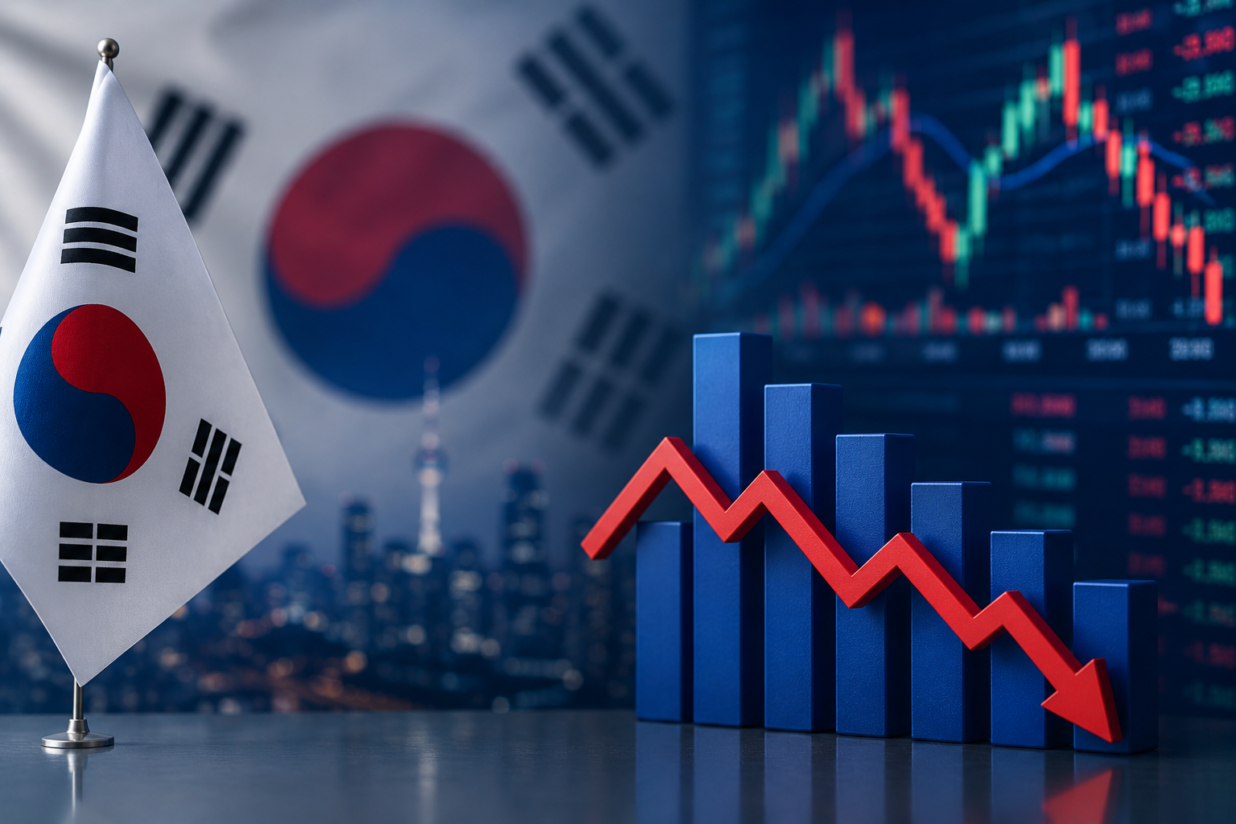
The South Korea stock market will remain under close government monitoring after sharp price swings unsettled investors. The move comes as financial authorities seek to maintain market confidence and reduce the risk of excessive volatility while uncertainty surrounding the technology sector continues to grow.
Following sharp changes in the country’s main stock index on Wednesday, government officials convened a high-level meeting. Policymakers agreed to keep a tight eye on financial markets and be prepared to act if situations deteriorated.
South Korea Stock Market Faces Fresh Volatility Concerns
South Korea’s Finance Minister met with senior officials, including central bank and financial regulators, to discuss recent developments in the country’s financial markets. Officials agreed that maintaining market stability is a primary goal as investors adapt to shifting global economic conditions.
The recent sell-off followed a stunning surge earlier this year, which sent South Korean stocks to new highs. However, profit-taking by foreign and institutional investors, combined with shifting expectations for artificial intelligence (AI) investments, has heightened market instability.
The benchmark KOSPI index fell sharply before recovering a portion of its losses. Even after the rally, the index remained significantly below its recent peak, indicating that investors are becoming increasingly cautious.
Technology companies have been at the core of recent market swings. Major semiconductor companies, like Samsung Electronics and SK Hynix, saw huge price swings as investors questioned if the strong AI-driven growth observed in recent months would continue at the same rate. Because these firms are heavily weighted in the index, their performance has had a significant impact on the whole South Korean stock market.
South Korea Stock Market Under Pressure Amid AI Investment Concerns
Financial regulators are particularly concerned about the increasing popularity of single-stock leveraged exchange-traded funds (ETFs). These investment instruments let traders to take larger stakes in particular equities, but they can also boost market volatility during periods of intense buying and selling.
The Financial Supervisory Service announced that it will investigate if these leveraged ETFs are leading to excessive price swings. Authorities may also look into how asset management firms offer their products to ordinary investors.
The Bank of Korea has warned that concentrated investment in a small number of technology stocks could increase financial risks. Officials believe one-sided trading through leveraged products may amplify market swings instead of reducing them, adding further pressure to the South Korea stock market.
Despite the recent drop, economists say the country’s long-term economic prognosis is still bolstered by its globally competitive semiconductor industry and robust export sector. However, investors are anticipated to remain cautious until more information is available on global AI demand, corporate results, and the future for technology businesses.
Market observers expect regulators to closely watch trading activity in the coming weeks. Any new actions are expected to be aimed at ensuring orderly trading conditions rather than actively meddling in routine market operations.
For the time being, South Korea’s financial leadership thinks that rigorous supervision, quick policy action, and thorough market oversight would assist restore investor confidence while also allowing the South Korean stock market to naturally react to shifting global economic conditions.
- Join our whatsapp channel for daily updates.
- Follow tazatimesnews Telegram Channel for latest news alerts.
- Follow TazaTimesNews on TruthSocial for exclusive updates
- Also reads : 10 methods to manage high blood pressure without medication.