
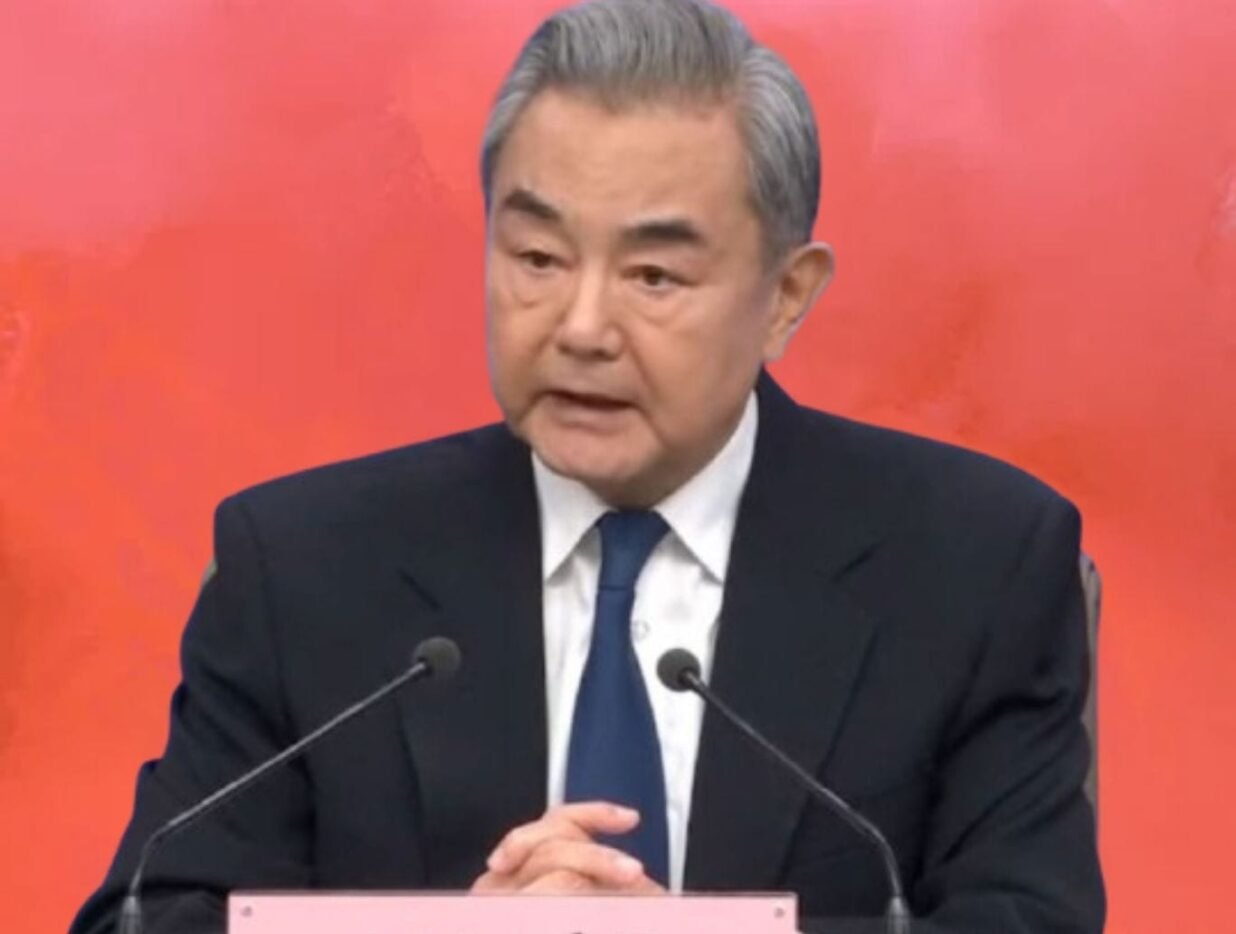
Beijing [China]: During a news conference on the margins of the fourth session of the 14th National People’s Congress in Beijing, Chinese Foreign Minister Wang Yi urged greater cooperation between New Delhi and Beijing.
The senior diplomat highlighted the importance of bilateral cooperation, saying, “India and China must step up and support each other’s BRICS presidency over the next two years.” These remarks come at a moment of great global upheaval, particularly in the intensifying US-Iran rivalry in West Asia.
Wang Yi emphasised the potential for a united front between the two Asian powers
Wang Yi emphasised the potential for a united front between the two Asian powers and the impact their collaboration may have on the international scene. “Together, we can bring new hope to the Global South,” he said, implying that coordinated leadership within the BRICS group might act as a stabilising force for developing countries.
In addition to strengthening regional connections, the Chinese Foreign Minister opposed the joint US-Israeli military operation against Iran, claiming that the escalation should “never have happened”. According to Al Jazeera, the senior diplomat demanded a “immediate” end to the current hostilities and a prompt resumption to diplomatic negotiations.
During the same news conference in Beijing, Wang Yi stressed that using military force “will never resolve” the region’s deep-rooted crisis. He warned that the use of force weakens the established international order, noting, “A powerful fist does not imply strong reason. The world cannot return to the law of the jungle.
Also reads : US Senate rejects proposal to stop military campaign against Iran
According to Al Jazeera, the Foreign Minister reiterated China’s strong opposition to any attempts to destabilise the Iranian regime. Wang stated that he believes there is no popular support for regime change in Iran, implying that such ambitions will simply exacerbate regional tensions.
Beijing’s demand for caution came after the Israel Defence Forces (IDF) reported that the Israeli Air Force (IAF) conducted targeted strikes on multiple Iranian military targets in the capital city. In an X post, the military official account wrote, “STRUCK: Several Fuel Storage Complexes Belonging to the IRGC in Tehran.”
The operation, which was “guided by IDF intelligence,” targeted specific areas designated by the military as distribution hubs for various armed units. The Israeli Defence Forces said, “IAF struck these complexes, where the Iranian terrorist regime would distribute fuel to multiple military entities in Iran.”
Regarding the mission’s impact, the military claimed that “the strike significantly deepens the damage to the military infrastructure of the Iranian terrorist regime.” The notification was accompanied by an accompanying graphic that identified a “fuel storage facility in Tehran used by the military forces of the Iranian terror regime,” emphasising the strategic importance of the targets chosen during the operation.
Adding weight to the military assessments, US President Donald Trump stated on Saturday (US local time) that the US had eliminated Iran’s entire leadership and described the measures as removing a massive ‘cancer’ from the face of the world.
When questioned if the US was responsible for the bombing of an elementary girls’ school in Iran, Trump bluntly denied the charges and accused Iran for the bombing, emphasising the inaccuracy of Iranian weapons.
Trump responded, “No, I don’t believe so. Based on what I’ve observed, Iran did this. We believe Iran was responsible since, as you are aware, their bombs are notoriously inaccurate. They have absolutely no precision. It was accomplished by Iran.” He made the remarks while on Air Force One en way to Miami.
He described the scope of the devastation, saying, “We destroyed their (Iranian) navy, 44 ships. We have destroyed their whole air force, including every jet. We’ve destroyed most of their missiles. You can tell that the rockets aren’t coming as frequently as before. We’ve also targeted their industrial facilities, where they produce the missiles. Their drone capability is significantly reduced, and we’ve hit them where it hurts, wiping out nearly every kind of leadership possible.”
Despite the collapse of Iran’s military capacity, US Special Envoy Steve Witkoff, who was also on Air Force One, informed the reporters that a diplomatic settlement is still possible, but it is up to the President.
Referring to earlier failures, Witkoff stated, “But they didn’t appear to be that amenable in that first series of conversations. You’ve heard what I said. They said that we have an innate right to enrich. They boasted of possessing 60 percent enriched fuel, enough for 11 bombs. And they told me and Jared, ‘We’re not going to give you something you can’t take militarily.’ So, you know, I think they’ll need to adjust their mindset.”
The current scenario stems from a joint US-Israeli military operation on Iranian land on February 28, which resulted in the deaths of Supreme Leader Ayatollah Ali Khamenei and other senior officials, triggering a strong response from Tehran.
Iran responded by launching ballistic missiles and drones at US assets and allies in the region, including Israel, Bahrain, Kuwait, Qatar, Saudi Arabia, the United Arab Emirates, and Jordan, exacerbating the conflict in West Asia and increasing risks for civilians and expatriates alike.
- Join our whatsapp channel for daily updates.
- Follow tazatimesnews Telegram Channel for latest news alerts.
- Follow TazaTimesNews on TruthSocial for exclusive updates