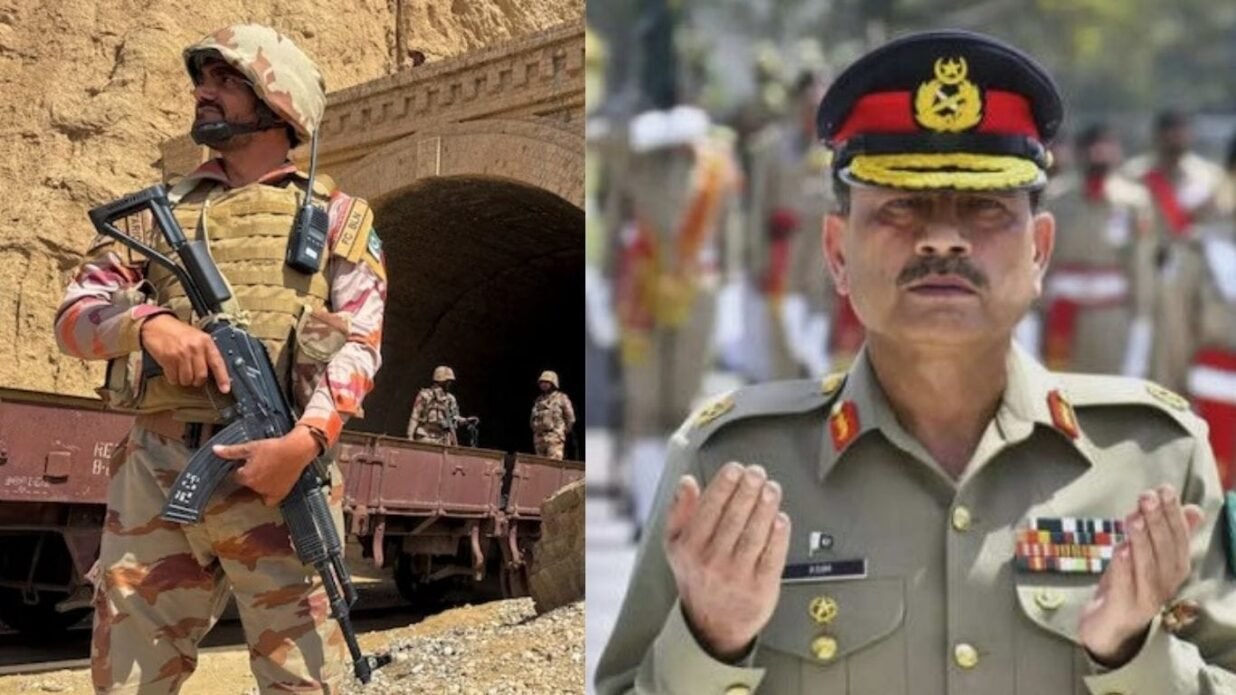
Pakistan’s worsening Balochistan catastrophe is now openly acknowledged by the country’s leaders. Defence Minister Khawaja Asif stated that security forces are “handicapped” when acting in the country’s largest province, raising new concerns about the military’s ability to suppress the insurgency. His remarks came amid an extraordinary escalation by the Baloch Liberation Army, which has carried out coordinated suicide and gun strikes across various districts, momentarily seizing important cities and security sites.
The admitting of physical and operational restrictions contrasts sharply with government claims of control. While Pakistan’s military claims to have killed almost 200 militants in counter-operations, the BLA has claimed considerably more losses among Pakistani personnel, showing a growing credibility gap and emphasizing the magnitude of the threat Islamabad is attempting to contain.
‘Physical handicap’ in Balochistan
Asif spoke to Pakistan’s National Assembly on Monday, painting a grim picture of the security situation in Balochistan.
“This is far more difficult to control than a populated city or area, and our forces must be deployed on a vast scale. Our forces are there and taking action against them, but there is a physical barrier to guarding and patrolling such a wide region,” he explained.

According to Dawn, Asif stated that Balochistan’s huge topography significantly hinders surveillance and control, citing the fact that “a person resides every 35 kilometers” in the region.
Also reads : Iran–US tensions : Donald Trump Sees Serious Talks, Tehran Says No to Forced Dialogue
He refused to negotiate with the BLA, citing their involvement in global mischief (fasad-ul-ard) and the inability to have talks.
Internal failures and smuggling networks
In a rare acknowledgment of internal corruption, the defense minister blamed political and bureaucratic favors for the province’s instability.
“This arrangement has led to the looting of the province’s riches. And this reaction is coming from the same people, the same nexus that attempted to stymie Balochistan’s rise,” he explained.
Balochistan, while being rich in minerals and natural resources, is Pakistan’s poorest province. The Baloch population, which numbers over 15 million, has long accused Islamabad of exploitation, enforced disappearances, and denial of political and economic rights.
Claims about advanced weaponry and Afghan sanctuaries
Asif further claimed that Baloch terrorists were employing advanced American-made weapons, raising concerns about Pakistan’s border security and intelligence failings.
He stated that the rebels possessed firearms valued PKR 2 million. “We don’t have the rifle. They also have infrared weapon sights worth $4,000 to $5,000. They own approximately $20,000 worth of military equipment. Where does it come from? “Who’s paying for it?” He inquired.
Asif said the guns were “American weapons” and that the insurgent leadership was operating from Afghan land. He also claimed that oil smuggling networks had hijacked the movement, claiming, “Billions and billions of rupees were being lost to smuggling, mostly oil smuggling. The criminal mafia […] started backing the cause. And their leadership now consists of these aspects.”
Operation Herof and opposing claims.
The remarks came after the BLA launched Operation Herof, which means “black storm,” and included coordinated strikes in Quetta, Mastung, Noshki, Dalbandin, Kharan, Panjgur, Tump, Gwadar, and Pasni, according to Pakistan’s military media wing.
According to Reuters, the attacks killed more than 22 security officers and 36 civilians. Pakistani forces said they retaliated with large-scale counterterrorism operations, killing 197 militants in over a dozen places.
However, the BLA has challenged Pakistan’s version. According to a statement reported by Moneycontrol, the group claimed that at least 280 Pakistani servicemen were killed during Operation Herof Phase II and that its forces had taken critical locations in regions including Nushki. The BLA also claimed that Pakistani forces were retiring under pressure, which Islamabad has not confirmed.
In Nushki, militants briefly took over a police station and other facilities, resulting in a three-day standoff. “More troops were sent to Nushki,” a security officer confirmed to Reuters. “Helicopters and drones were used against the militants.” Police stated seven people were slain before control was restored.
Blame game and strategic drift.
Islamabad has again accused India for the violence, which New Delhi categorically denies. India’s Ministry of External Affairs has stated that Pakistan should address the “long-standing demands of its people in the region” rather than externalising its failures.
As Pakistan’s own defense minister concedes to operational handicaps, expansive terrain, and institutional collusion, the Balochistan crisis appears to be more than a transitory security challenge.
- Join our whatsapp channel for daily updates.
- Follow tazatimesnews Telegram Channel for latest news alerts.
- Follow TazaTimesNews on TruthSocial for exclusive updates