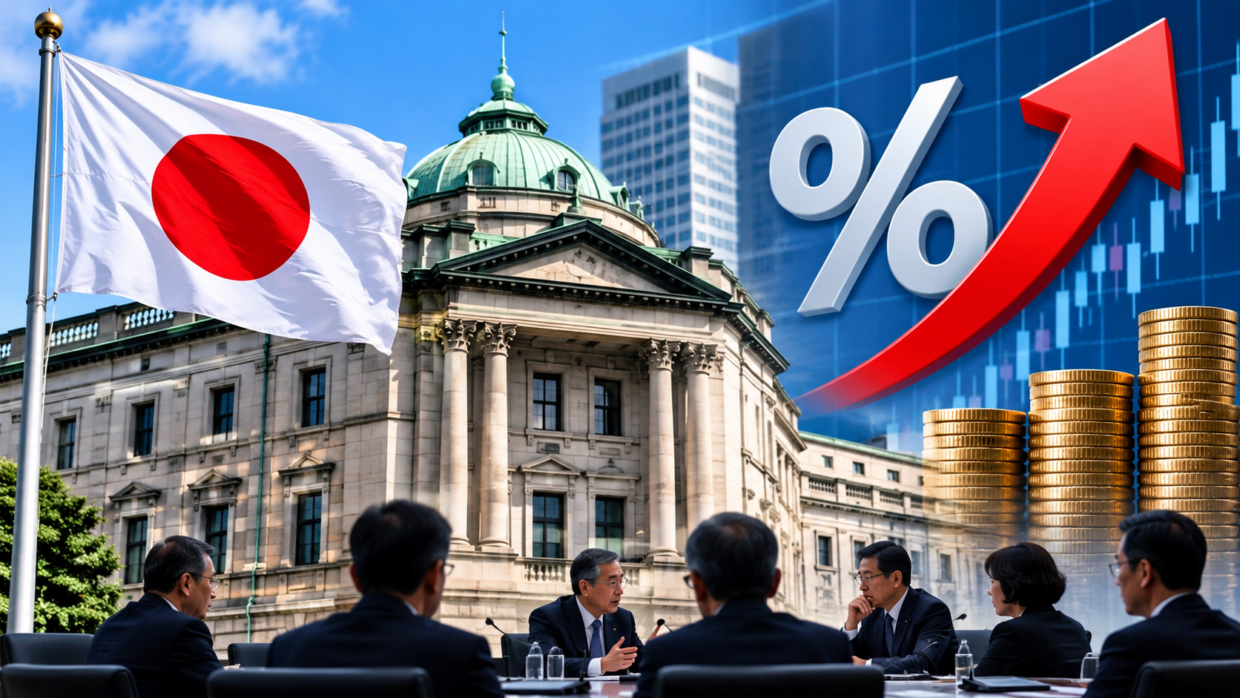
Bank of Japan Rate Hikes : The Bank of Japan (BOJ) is facing mounting requests from its policy board to hike interest rates sooner. According to a summary of thoughts from its October meeting, some members want the central bank to move faster now that underlying inflation has attained its target of 2%.
However, not everyone favours a faster approach. Several policymakers believe the BOJ should take more time since household spending remains low and the strength of demand associated with artificial intelligence is questionable. This disagreement underlines the dilemma that Governor Kazuo Ueda faces as the bank evaluates its next move.
The debate has also increased attention on the central bank’s December meeting. One policymaker said the next increase should happen without excessive caution. Others argued that Japan needs to move its policy rate closer to a level that neither slows economic activity nor pushes it too high.
Bank of Japan Rate Hikes Gain Support as Inflation Reaches Target
At its October 29-30 meeting, the BOJ maintained its benchmark interest rate at 1.25%. At the same time, it announced that its long-term endeavour to meet the 2% pricing target had been successful. The bank also mentioned the likelihood of more price hikes, keeping expectations of tighter monetary policy alive.
One board member stated that Japan had reached a new stage in which the central bank should accelerate the transition to a neutral interest rate. Two other members agreed to reach that level sooner.
However, other lawmakers want the bank to assess the impact of each rise before moving forward. One member proposed evaluating financial circumstances over several months following each rate decision.
There are also concerns about the impact of rising borrowing costs on firms and families. One expert cautioned that future hikes could undermine economic growth and put pressure on underlying inflation as monetary support is withdrawn.
Still, another member suggested that raising interest rates could help the economy’s overall balance. Although it would limit company investment, the member thought it was unlikely to hurt household consumption.
Japan has continued to confront inflationary pressures from rising energy costs and more expensive imports due to the weak yen. The BOJ hiked interest rates in June and again in September, faster than the approximately twice-yearly pace projected in 2024 and 2025.
The current policy rate is now within the estimated neutral range of 1.1% to 2.5% calculated by BOJ staff. This has made the possible final level of interest rates an important question for investors. Board member Naoki Tamura has suggested that Japan’s neutral rate may be around 2%, although other policymakers have avoided giving a specific estimate.
Bank of Japan Rate Hikes Depend on Wages and Growth
Wage increase is another key issue in the argument. Some BOJ members feel that next year’s annual salary talks will help determine whether inflation stays near to the central bank’s 2% objective.
The opinions on the expected outcome are split. According to one policymaker, pay rises next year will likely be sufficient to meet the inflation objective. Another member, however, expects minimal progress over this year.
The second viewpoint expresses concern that increasing prices have not yet resulted in better wage growth. Maintaining inflation near the target may become more difficult if wages do not rise consistently.
Economic difficulties are also contributing to the uncertainty. Data released on Tuesday revealed that household expenditure declined more than expected in September. Poor weather contributed to the reduction, raising questions about the strength of consumer demand.
Meanwhile, market projections suggest another rate hike in December. Reuters questioned analysts, who expect the BOJ to raise its policy rate to 1.5% and then boost it roughly every three months. The majority of those polled estimate the eventual high to be 1.75% or 2%.
The board’s differences are also reflected in earlier decisions. Two members appointed by Prime Minister Sanae Takaichi opposed the September rate increase. Their position adds to the divide between policymakers who favour quicker action and those who are more cautious about economic growth.
Conclusion: What to Expect From the BOJ
The October meeting report demonstrates that the Bank of Japan is still evaluating inflation risks against the need to maintain economic development. Some members urge faster action now that underlying inflation has surpassed the 2% objective. Others argue for a more cautious approach, citing low consumer expenditure and wage insecurity.
The December meeting will be significant as the central bank assesses whether another increase is warranted. Market predictions presently point to a move to 1.5%, but the final decision will be based on the economic situation. Wage negotiations, consumer demand, and the effects of previous rate hikes are expected to remain key to the debate. For the time being, the BOJ has not decided on a specific rate of future tightening.
- Join our whatsapp channel for daily updates.
- Follow tazatimesnews Telegram Channel for latest news alerts.
- Follow TazaTimesNews on TruthSocial for exclusive updates
- Also read : India Crush Sri Lanka by 124 Runs, Reach Asian Games Cricket Final Against Pakistan