
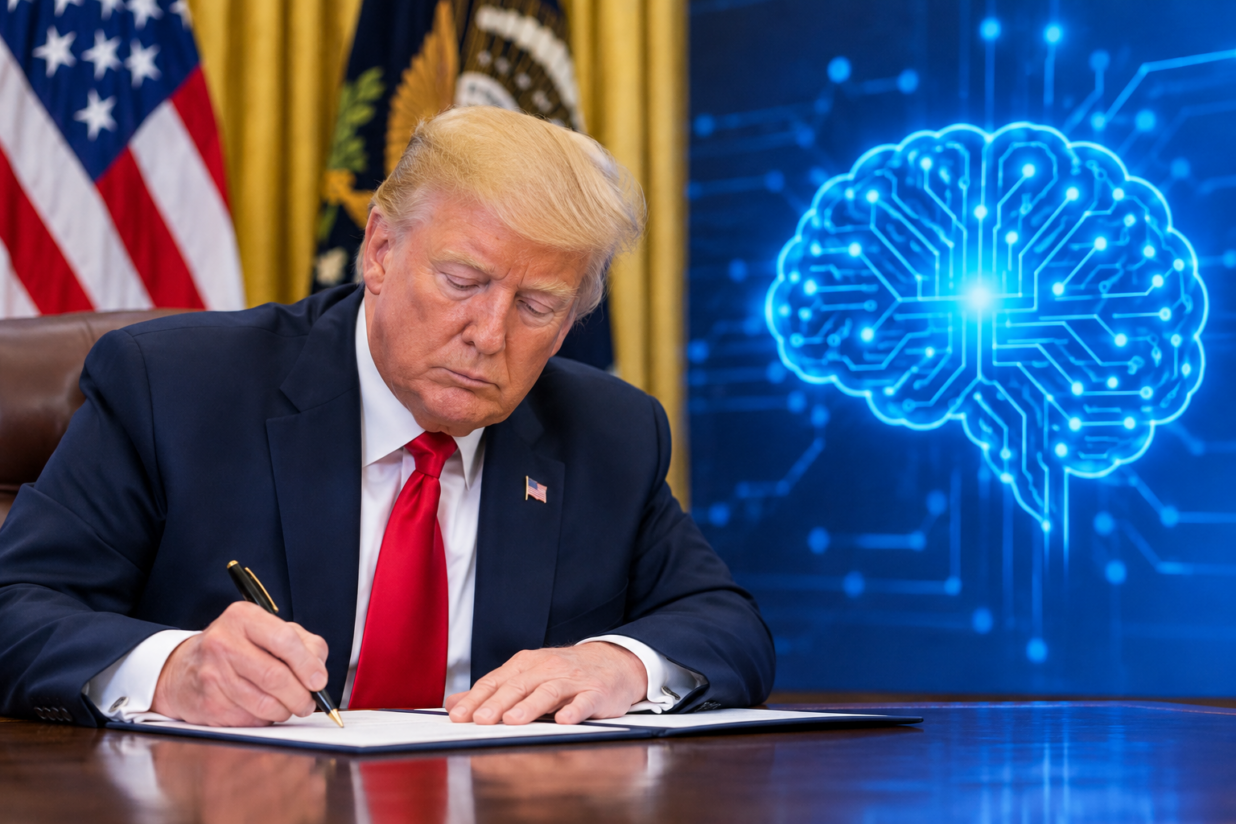
Trump Super Intelligence :US President Donald Trump has issued an executive order requiring government agencies to replace the word ‘artificial intelligence’ with ‘Super Intelligence’, or ‘SI’. The directive, signed in September 2026, seeks to alter how the US government portrays fast evolving AI technology and indicates the administration’s desire to speed its development.
According to the executive order titled “Inaugurating the Era of Super Intelligence,” contemporary AI systems are capable of more than just automating and mimicking human intelligence. The American government feels that these technologies could reflect the potential. The American administration believes that these technologies could generate opportunities.
Speaking to reporters on Tuesday, Trump also backed the ruling. He said that the new word more accurately captures the technology’s expanding capabilities and that it should not be referred to as artificial.
Trump Super Intelligence Order Directs Federal Agencies to Use ‘SI’
The new executive order mandates that “Super Intelligence” or “SI” be used in official communications by federal entities. The change will apply to official websites, publications, policy documents and other government materials that allude to the technology.
Additionally, Michael Kratsios, head of the Office of Science and Technology Policy, has been tasked by the White House with determining whether the government should broaden or modify its definition of super intelligence. The goal of the action is to give federal agencies a uniform method for characterizing sophisticated AI systems.
Nevertheless, this does not indicate that a new technology has been invented. The term “int refers to a hypothetical AI is used to allude to a human intellectual intelligence.
No such system has been achieved thus far. Instead, the executive order represents the administration’s assessment of the speed at which AI capabilities are developing and how the government ought to characterize their potential going forward.
Trump Pushes for Faster AI Development in the US
The Trump continues to encourage the United AI development. Excessive regulation, according to his administration, may hinder innovation and harm the nation’s standing in the international technological sector.
Trump has frequently urged US IT firms to maintain their competitiveness, especially in light of China’s escalating rivalry. The administration believes that AI leadership is crucial for both national security and economic expansion.
The president has also rebuffed warnings from several AI whistleblowers about insufficient monitoring. He has dismissed some fears as overstated, arguing that businesses should be permitted to build advanced technology while implementing their own safety precautions.
However, the rapid growth of AI has sparked concerns about its potential impact on jobs, cybersecurity, and government operations. Concerns have also been raised about AI agents accessing government websites and the use of autonomous systems in cyberattacks.
Critics believe that as AI systems get more powerful, present protections may fail to handle the hazards. These concerns have fuelled the debate over how governments should balance technical advancement with public safety.
White House AI Meeting Focuses on Industry Responsibilities
The executive order was issued on the same day that technology executives met at the White House to sign an agreement dubbed a’morally binding’ AI constitution.
The agreement aims to set rules for developing and managing sophisticated AI systems. However, specifics regarding its exact provisions and how they would affect future government initiatives were not immediately evident.
The gathering brought together executives from prominent companies active in AI and related technologies. Their participation emphasised the administration’s strategy of involving the private sector in establishing expectations for advanced AI development and deployment.
Trump’s recent decision is consistent with his overall goal of pushing American companies to enhance their AI capabilities while relying on industry-led protections. The transition from artificial intelligence to Super Intelligence is essentially a government language decision, with ongoing discussions about AI legislation, safety, and responsibility.
- Join our whatsapp channel for daily updates.
- Follow tazatimesnews Telegram Channel for latest news alerts.
- Follow TazaTimesNews on TruthSocial for exclusive updates
- Also read : Shafali Verma two world records: India star makes history against Pakistan