
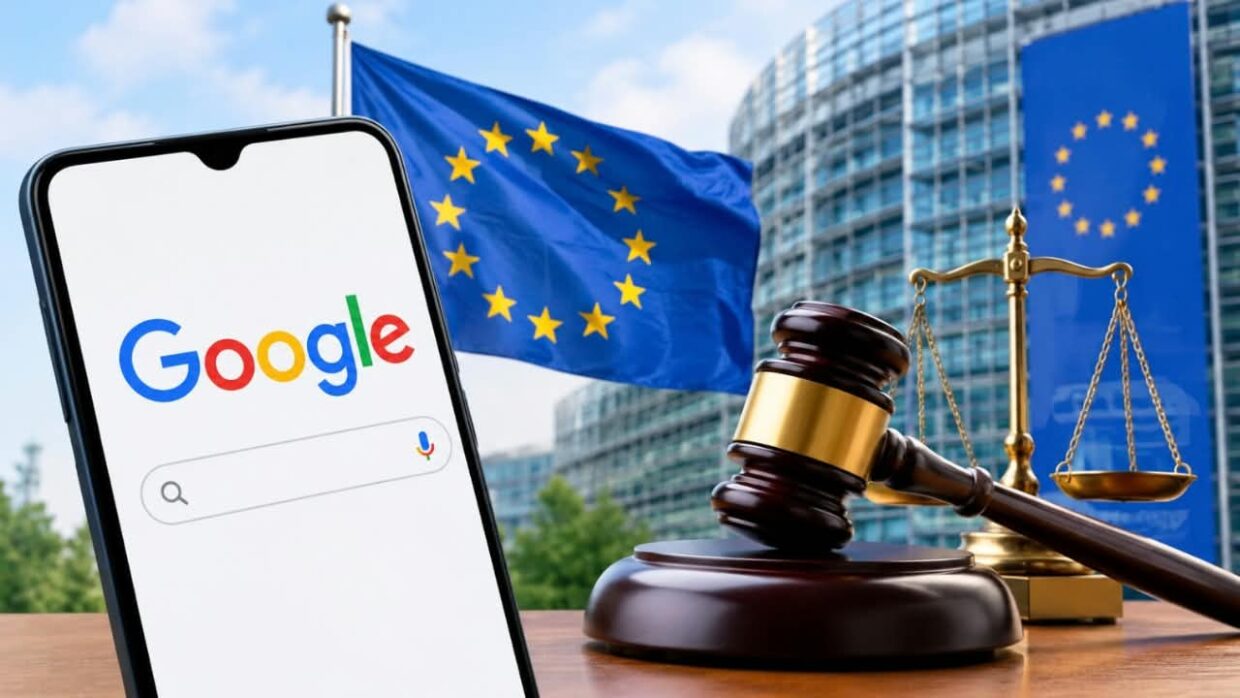
Google has challenged two European Union orders that require the company to open its services to artificial intelligence developers and search-engine rivals. The US technology giant filed legal challenges at the General Court in Luxembourg on Monday, September 28, arguing that the measures could put users’ privacy and security at risk.
The arguments revolve around the EU’s Digital Markets Act (DMA), which seeks to improve competition in the technology sector by limiting the influence of major digital companies. According to Google, the new regulations may force it to reveal sensitive user information while also weakening crucial security measures.
Google Challenges EU Orders Over Privacy and Security
The two EU judgements imposed in July require Google to grant wider access to its services and search data. One step tries to enable competing search engines access specific Google search information, while the other aims to provide artificial intelligence developers with access to services used by Google’s Gemini AI model.
Google has expressed concern about how the restrictions may damage the privacy of those who use its products. The company claims that publishing search results without appropriate anonymisation could reveal sensitive information about users.
Google’s senior director of competition, Oliver Bethell, stated that the corporation is fighting the judgements due to privacy and security concerns. He also warned that the regulations could impair Android’s built-in security measures.
According to Bethell, people frequently use Google Search to find answers to deeply personal enquiries, such as those about health and relationships. He contended that providing such information without proper controls could result in long-term harm to user privacy.
Google’s legal action tries to dispute EU requirements before they go into effect. The corporation claims that exposing its services to competitors should not jeopardise the security and confidentiality of its users’ information.
EU Defends Digital Markets Act Requirements
The European Commission, which is in charge of executing the Digital Markets Act, justified the two measures. The Commission stated that the standards include rigorous protections to preserve user privacy, device integrity, and security.
The DMA was established to resolve competitiveness issues among big technology businesses. It imposes certain duties on designated large digital platforms with the goal of enabling smaller competitors and new market entrants more possibilities to compete.
According to the July decisions, Google must take efforts to make key services and data more accessible to competitive businesses. The changes are set to take effect next year, making legal challenges more important for both Google and its competitors.
The debate underscores divergent perspectives on how technology businesses should balance competition and data protection. While EU regulators seek to open up digital markets, Google contends that the planned access rules may pose hazards to users if privacy safeguards are insufficient.
DuckDuckGo Supports EU Measures as Legal Dispute Continues
DuckDuckGo, a US-based firm famed for its privacy-focused search engine, has backed the European Commission’s approach. The company does not follow users’ search history or collect personal information in the same way that some competitors do.
A DuckDuckGo representative supported the EU-mandated anonymisation scheme, calling it as strong. The representative also said that Google’s legal efforts would primarily delay the implementation of the rules.
Google’s appeals will now be heard by Europe’s second-highest court, the General Court in Luxembourg. The court will review the company’s challenges to EU directives, but the outcome and timeframe of the proceedings are uncertain.
The case may have far-reaching repercussions for how global technology companies share data and allow access to their services throughout Europe. Google and EU authorities are still divided on whether the new competition rules provide adequate customer protection while allowing competitor companies to grow their products.