
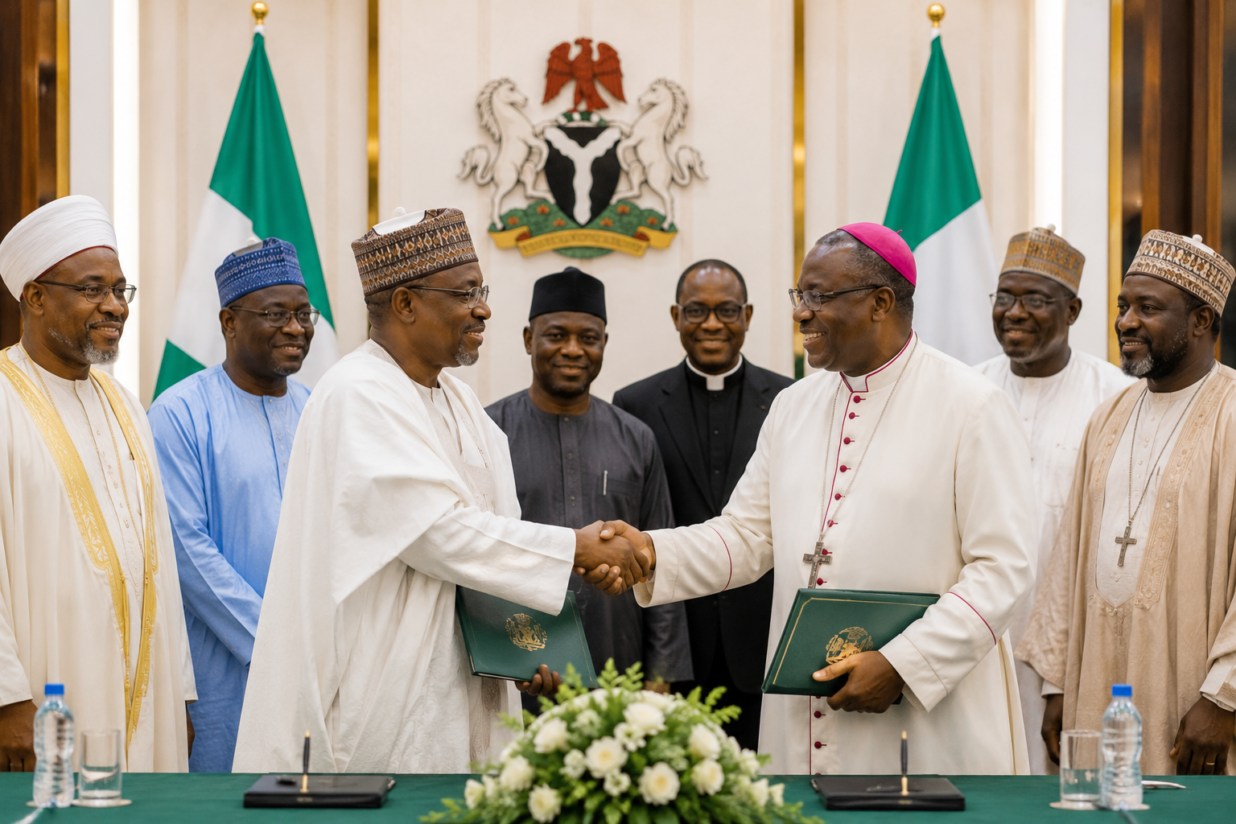
Nigeria Faith Leaders : More than 50 Muslim and Christian leaders in Nigeria have signed a historic peace agreement aimed at promoting religious unity and lowering tensions throughout the country. The agreement was signed in Abuja on Wednesday, August 12, 2026, as part of a two-day interfaith summit organized by the Saudi Muslim World League.
The idea comes as Nigeria faces major security and religious concerns. The country is roughly divided between a primarily Muslim north and a predominantly Christian south, and violence by extremist organizations and communal strife has exacerbated long-standing tensions in numerous areas.
The conference also saw the establishment of a new interfaith organization aimed at strengthening collaboration between Muslim and Christian communities and encouraging peaceful communication throughout the country.
Nigeria Faith Leaders Seek Unity Against Extremism and Hate Speech
The peace project follows remarks made by US President Donald Trump in late 2025 about violence impacting Christian communities in Nigeria. Trump criticized Nigeria for atrocities on Christians and threatened military action against Islamist extremists, focusing international attention on the country’s security crisis.
Nigerian officials, on the other hand, have denied that Christians are being targeted specifically, claiming that insecurity has impacted both Muslim and Christian communities. During the peace accord ceremony in Abuja, Trump’s words were not explored in detail.
Religious leaders from both faiths utilized the conference to highlight collaboration rather than division. They stated that the agreement will offer a better foundation for Muslims and Christians to collaborate and develop peaceful relations in their communities.
Mohammad Al-Issa, the Muslim World League’s secretary-general, warned of the risks of extremism and asked religious leaders to unite against groups that use faith to justify murder and hatred.
Participants also emphasized the need of combating hate speech, pointing out that religious leaders wield tremendous power in local communities and may play a key role in conflict resolution.
Nigerian authorities who attended the occasion lauded the agreement as a crucial step toward national reconciliation. Deputy Senate President Barau Jibrin was among the senior government officials who emphasized the value of unity and cooperation.
While the deal is unlikely to immediately address Nigeria’s security concerns, advocates say it establishes a foundation for ongoing discourse and stronger collaboration between the country’s two main religious communities.
Nigeria Faith Leaders Sign Peace Accord Ahead of 2027 Election
The timing of the agreement is especially crucial because Nigeria is gearing up for its presidential election in January 2027. Religious identity is predicted to remain a major topic during the campaign.
President Bola Tinubu’s ruling party has maintained a Muslim-Muslim ticket, a political arrangement that has sparked national interest because prior political traditions have frequently sought a balance of Muslim and Christian representation.
In this context, the peace treaty provides an opportunity for religious leaders to persuade political parties and voters to avoid using faith as a source of separation during the election season.
Nigeria continues to suffer extremist violence and communal conflicts, making collaboration among religious institutions more crucial. The new agreement has both symbolic and practical significance, but its success will be determined by whether the commitments made in Abuja result in ongoing discourse and effective action at the grassroots level.
As the 2027 election approaches, Nigerian faith leaders are expected to play an important role in fostering peace, condemning hate speech, and avoiding political issues from devolving into religious violence.
- Join our whatsapp channel for daily updates.
- Follow tazatimesnews Telegram Channel for latest news alerts.
- Follow TazaTimesNews on TruthSocial for exclusive updates
- Also reads : China Inflation Eases in July with Factory-Gate Prices at 3-Month Low